The Prahlada yagna at Mantralaya is the reason a saint once turned down fertile estates for a barren village. Manchale, as the place was then called, yielded almost no crops and almost no revenue. Yet Sri Raghavendra Swamy asked for that village and refused every richer alternative. What he wanted lay buried under the soil: a fire altar he said he had lit himself, in an earlier birth.
Sri Raghavendra Swamy Matha (srsmatha.org.in) is an independent pilgrim guide. We are not affiliated with, endorsed by, or the official website of Sri Raghavendra Swamy Matha, Mantralayam, and we accept no bookings, sevas or donations. For rooms, sevas and official announcements, please use the Matha’s own portal at srsmatha.org.
The Prahlada Yagna at Mantralaya: Legend at a Glance
- Manchale is the older name of Mantralayam, a village in Kurnool district of Andhra Pradesh, on the banks of the Tungabhadra.
- The Prahlada yagna at Mantralaya was the first of three reasons Rayaru gave for choosing the site.
- The other two were Manchalamma as his family deity, and a Mahabharata-era battle fought over the same altar.
- Nawab Siddi Masud Khan of Adoni gifted the village, although his Diwan Venkanna argued hard for better land.
- Venkanna built a sanctum over the old yagna spot, next to the Manchalamma shrine, and that spot became the Moola Brindavana.
- Rayaru entered the Brindavana alive in 1671, on Shravana Krishna Dwitiya of Virodhikruth Samvatsara.
Why the Prahlada Yagna at Mantralaya Decided Everything
The Prahlada yagna at Mantralaya sanctified that ground permanently, and Rayaru wanted his final seat placed on it. He named three reasons aloud before entering the Brindavana. Manchalamma had been his family deity in that earlier birth. Finally, the spot had already proved its power once, during the Mahabharata era.
This account is not travellers’ folklore. It comes from the Matha’s own life history of Rayaru, drawn from the Kannada Guru Charite of Vedavyasacharya. Because the source is the Matha itself, it is the version worth trusting whenever online retellings disagree.
Where the Prahlada Yagna at Mantralaya Took Place
Prahlada, the child devotee rescued by Lord Narasimha, performed a large yagna at Manchale in an earlier yuga. Rayaru did not describe the site as a place that would become holy later. It was holy already, so he wanted the exact spot and nothing near it.
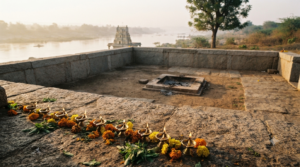
Diwan Venkanna is said to have dug where Rayaru pointed, close to the Tungabhadra, and uncovered the remains of a homakunda. Some retellings call the find a bali peetha instead. Either way, that discovery is what convinced the disciples that a worthless-looking village held a hidden history.
Manchalamma and the Family-Deity Link
Manchalamma, also called Mantralayambika, is the grama devata or village guardian of Manchale. The village took its name from her, and the Sanskritised form of that name became Mantralaya. Rayaru identified her as the kuladevata he had worshipped as Prahlada, so the ground carried a personal claim as well as a sacred one.
On arriving in the village he went straight to her shrine and asked permission to settle there. Devotees hold that he promised her a lasting courtesy in return. Whoever came for his darshan would see her first, and that sequence is still followed inside the Matha complex today.
Arjuna, Anusalva and the Chariot on the Altar
The third reason is the strangest, and it is the one most retellings mangle. In the Dvapara yuga, Arjuna was guarding the horse of Dharmaraja’s Ashvamedha yaga when a king named Anusalva challenged him at Manchale. Anusalva’s chariot happened to stand over the old kunda of the Prahlada yagna at Mantralaya, which made him unbeatable.
Arjuna could not break through, so he prayed to Krishna for guidance. Krishna told him to pull his chariot back slightly. Reading the move as retreat, Anusalva charged forward and rolled clear of the sacred spot. He lost the battle in that instant.
The Three Reasons, Side by Side
Rayaru’s explanation works as one argument, not three loose legends. Each reason attaches to a different era, yet all three point at the same patch of earth.
| Reason Rayaru gave | Era in the tradition | Where it sits in Mantralaya now |
|---|---|---|
| Prahlada’s yagna sanctified the spot | Krita yuga, Prahlada’s lifetime | The sanctum around the yagna spot, now the Moola Brindavana |
| Manchalamma was his kuladevata | Same birth as Prahlada | Manchalamma shrine, visited first by devotees |
| Anusalva’s chariot proved the spot’s power | Dvapara yuga, Mahabharata era | No separate marker; recalled in the Matha’s account |
How Prahlada and Rayaru Are Connected
Rayaru is held to be the fourth earthly form in a single lineage of souls. The Matha lists the order as Shankukarna, then Prahlada, then Bahlika Raja, then Vyasaraja, and finally Sri Raghavendra Teertha. Shankukarna was a celestial who assisted Chaturmukha Brahma, and his descent to earth cleared the path for the Narasimha avatara.
Acharya Madhva’s Mahabharata Tatparya Nirnaya records that Prahlada carried an avesha of Vayu, which explains the strength attributed to him. Our detailed piece on Raghavendra Swamy’s incarnations sets out the full chain with sources. The short version matters here for one reason. When Rayaru spoke about the Prahlada yagna at Mantralaya, he was describing his own act.
How the Prahlada Yagna at Mantralaya Outweighed Fertile Land
Nawab Siddi Masud Khan of Adoni had once tested Rayaru with covered plates of meat offered as naivedya, and the food turned to fruit and flowers. Shaken, the Nawab offered villages as amends. Rayaru refused at first, since a sanyasi has no use for property.
Venkanna kept pressing, so Rayaru finally named one village: Manchale, on the Tungabhadra. Venkanna was dismayed, because the land grew nothing and returned almost no revenue. He offered fertile alternatives more than once. Rayaru would take nothing else.
That refusal is the detail most travel pages skip, although it carries the whole point. He was not accepting a reward for a miracle. He was retrieving one specific piece of ground, and its market value never entered the calculation.
What Marks the Prahlada Yagna at Mantralaya Today
Venkanna had a garbha gudi built around the old spot of the Prahlada yagna at Mantralaya, adjacent to the Manchalamma temple. He also commissioned a beautiful Brindavana for his guru. Rayaru refused it and told him to keep it for a worthy successor, and that structure later became the Brindavana of Sri Vadeendra Teertha.
For his own Brindavana, Rayaru took Venkanna to a remote spot and pointed at a black rock. He said Lord Rama had rested on it while searching for Sita, so the stone was already sanctified. A parallel tradition places that rock at Madhavaram, a village a few kilometres away.
On Shravana Krishna Dwitiya of 1671, he sat in padmasana at the chosen spot after delivering his last discourse. His disciples raised the slabs around him. They then placed a copper box holding 1,200 Lakshminarayana shaligramas brought from the Gandaki river, and sealed the top with earth.
Myths About the Prahlada Yagna at Mantralaya
Five versions circulate widely online, and each one drops something the Matha’s record states plainly. Correcting them is not pedantry, because these errors change who did what, and when.
Myth 1: Prahlada performed the yagna in Dvapara yuga
Several pages date the yagna to the Dvapara yuga, and some even say Prahlada offered it to Lord Rama. In the tradition, Prahlada belongs to the Krita yuga and to the Narasimha avatara. The Dvapara episode is the Arjuna and Anusalva battle, fought much later over the same altar.
Myth 2: The Nawab gifted Mantralaya as a reward
The grant did follow the Nawab’s change of heart, yet Rayaru chose the village and had to insist on it. Writing it up as a generous royal gift reverses the story. The Nawab wanted to give more, while Rayaru wanted exactly this.
Myth 3: Mantralaya simply means “abode of mantras”
The Sanskrit reading is attractive, and mantra japa certainly happens there. Still, the name traces back to Manchalamma and to the village called Manchale or Manchali. Mantralayambika is her other name, so the two explanations are linked rather than rival.
Myth 4: The second Brindavana belongs to Prahlada
The Brindavana beside Rayaru’s is often mislabelled on social media. It belongs to Sri Vadeendra Teertha, the fifth pontiff after Rayaru. It is the very structure Venkanna had built and Rayaru declined.
Myth 5: Arjuna fought Anusalva during the Rajasuya yaga
Some retellings swap the yaga itself. The Matha’s account names the Ashvamedha yaga of Dharmaraja, with Arjuna guarding the sacrificial horse. Where sources differ on details like this, treat the Matha’s own text as the reference.
Tracing the Prahlada Yagna at Mantralaya on the Ground
Reading the story is one thing, but walking it is what makes it stick. Pilgrims can follow the Prahlada yagna at Mantralaya in the order tradition sets out, and the whole circuit fits into a single morning.
- Manchalamma shrine first. She granted the land, so her darshan comes before the Brindavana.
- The Moola Brindavana. This is the yagna spot itself, the reason the village mattered at all.
- Sri Vadeendra Teertha’s Brindavana. Standing right beside it, this was Venkanna’s original commission.
- The Venkateswara temple. Rayaru consecrated this icon soon after arriving in Manchale.
- The Tungabhadra bank. Appanacharya crossed the flooded river from Bichale to reach his guru in time.
- Panchamukhi Anjaneya. A short ride away, covered in our guide to the Panchamukhi Anjaneya temple near Mantralaya.
What First-Time Visitors Get Wrong
Most people arrive expecting a large temple and find something quieter instead. The Brindavana is a stone structure rather than a towering gopuram, so the atmosphere carries the visit, not the architecture. Set expectations accordingly and the trip lands far better.
Seva slots, pooja timings and room availability shift with festivals and Aradhana crowds, so confirm current details on the official Matha portal before travelling. The district portal for Mantralayam in Kurnool district helps with road access and orientation. Our notes on places to visit near Mantralaya cover what else fits into the same trip.
One practical caution belongs here. Rayalaseema summers are punishing, queues run long on weekends, and the Tungabhadra rises fast during the monsoon. Carry water and any regular medication, keep elderly relatives out of the midday heat, and stay out of the river when the current looks strong. Devotional practices at Mantralaya are matters of faith and tradition, so they do not replace medical treatment when someone is genuinely unwell.
Before You Go
Mantralaya is not a random village that a saint happened to settle in. Rayaru identified it, argued for it, and refused better land to secure it. Manchalamma’s shrine, the Moola Brindavana and the Anusalva episode are three parts of one explanation rather than three separate stories.
Read the Matha’s own account before accepting the versions circulating online, then walk the site in the order tradition sets out. The legend reads very differently once you are standing on the spot.
Frequently Asked Questions
Where exactly was the Prahlada yagna at Mantralaya performed?
At the spot now occupied by the Moola Brindavana, adjacent to the Manchalamma shrine inside the Matha complex. Venkanna had a sanctum built around it on Rayaru’s instructions. Accounts describe a homakunda or bali peetha uncovered there during digging.
Why did Rayaru pick a barren village instead of fertile land?
Because the ground itself was the point. Rayaru told Venkanna he wanted Manchale specifically, refusing repeated offers of more productive villages from the Nawab of Adoni. Revenue value meant nothing to him against an already sanctified spot.
Was Sri Raghavendra Swamy really Prahlada?
In Madhva tradition, yes. The Matha records a lineage running Shankukarna, Prahlada, Bahlika Raja, Vyasaraja and then Sri Raghavendra Teertha. This is a matter of faith and testimony within the sampradaya rather than a historically documented claim, and it is presented that way here.
Why do devotees visit Manchalamma before the Brindavana?
Rayaru sought her permission before settling in her village and, by tradition, assured her that his visitors would see her first. The practice has held ever since. Her shrine sits in the north-western corner of the temple building.
Who was Anusalva, and how is he linked to the Prahlada yagna at Mantralaya?
Anusalva was a king who fought Arjuna at Manchale while Arjuna guarded the horse of Dharmaraja’s Ashvamedha yaga. His chariot stood over the old kunda of the Prahlada yagna at Mantralaya, making him invincible until Krishna’s advice drew him off it.
Does Mantralaya mean “abode of mantras”?
That reading is popular, though the name really comes from the goddess. The village was Manchale or Manchali after Manchalamma, whose other name is Mantralayambika. Mantralaya is simply the Sanskritised form of that older village name.
Whose is the second Brindavana next to Rayaru’s?
It belongs to Sri Vadeendra Teertha, the fifth pontiff in the line after Rayaru. Venkanna originally built it for Rayaru, who declined it and asked that it be kept for a worthy successor. It is not Prahlada’s, despite frequent claims online.
What stone was used for Rayaru’s Brindavana?
A black rock that Rayaru pointed out at a remote spot, saying Lord Rama had rested on it while searching for Sita. A parallel tradition identifies the source as Madhavaram, a village a few kilometres from Mantralaya.
When did Rayaru enter the Brindavana at Manchale?
In 1671, on Shravana Krishna Paksha Dwitiya of Virodhikruth Samvatsara, which is why Aradhana falls in the Shravana month each year. Gregorian conversions given by different sources vary slightly, so check the Matha’s panchanga for exact dates.