The Sri Raghavendra Mangalashtaka is the Sanskrit hymn devotees sing at the close of Rayaru’s pooja. Every verse ends with the same prayer for lasting auspiciousness. Yet almost no page explains what the individual shlokas actually say, so most devotees chant beautiful lines they have never had translated.
This guide walks through the composition theme by theme. It names the composer, explains the metre, and corrects two errors that have circulated on devotional websites for years.
Please note: srsmatha.org.in is an independent devotional guide for Sri Raghavendra Swamy devotees. We are not the official Sri Raghavendra Swamy Matha, we are not affiliated with it, and we accept no bookings, sevas, donations or payments of any kind. For seva bookings, room reservations and e-hundi offerings, use only the official Matha portal at srsmatha.org.
Sri Raghavendra Mangalashtaka at a Glance
- What it is: a mangala hymn, sung to invoke auspiciousness at the end of worship
- Composer: Sri Appannacharya, Rayaru’s closest disciple
- Language: Sanskrit
- Length: eight verses, followed by a phalastuti verse that states the benefit of recitation
- Metre: Shardula Vikridita, with nineteen syllables in each of the four lines
- Shared refrain: all eight verses close with the identical fourth line invoking Sri Raghavendra, king among ascetics
- Customary time: after Rayara pooja, on Thursdays, and during morning and evening sandhya
What Is the Sri Raghavendra Mangalashtaka?
The Sri Raghavendra Mangalashtaka is an eight-verse Sanskrit hymn of auspiciousness addressed to Sri Raghavendra Tirtha. An ashtaka simply means a composition of eight verses. Mangala means auspiciousness, so a mangalashtaka is sung at the conclusion of worship to seal the ritual with a blessing.
That placement matters. Because it comes last, the hymn functions as a farewell and a request together. The worshipper has offered the pooja, and now asks the guru to make the offering fruitful.
Madhwa households across Karnataka, Andhra Pradesh, Telangana, Tamil Nadu and Maharashtra sing it daily. Many devotees learn it by ear from elders long before they read a single word of Sanskrit.
Who Composed the Sri Raghavendra Mangalashtaka?
Sri Appannacharya composed it. He was Rayaru’s beloved disciple and lived at Bichale, a hamlet across the Tungabhadra from Mantralaya. Most of the Sanskrit hymns still chanted for Rayaru today trace back to him, including the famous Raghavendra Stotra and the Raghavendra Dandaka.
His story explains the emotional weight in the lines. When Rayaru prepared to enter Brindavana in 1671, he sent Appannacharya away on sanchara. Appannacharya learned the news and rushed back, but the Tungabhadra was in spate.
Devotional accounts say he swam across while composing the Raghavendra Stotra aloud. He reached Mantralaya as the last slab of the Brindavana was set in place. Because he wrote from that depth of separation, his hymns read less like formal praise and more like a disciple still speaking to his guru.
The official Sri Raghavendra Swamy Matha lists Appannacharya among the composers in its devotional audio library, alongside Sri Vyasaraja Tirtha.
How the Sri Raghavendra Mangalashtaka Is Built: Metre and Refrain
Understanding the structure makes the meaning far easier to follow. Appannacharya wrote every verse in Shardula Vikridita, a demanding classical Sanskrit metre. Each line carries exactly nineteen syllables, and each verse carries four lines.
The Sri Raghavendra Mangalashtaka keeps one metre throughout, while the Dandaka does not. That metre is why the hymn sounds so stately when chanted correctly. It rolls in long waves rather than short beats, and the pace naturally slows the reciter down.
The design feature devotees notice first is the refrain. All eight verses end with the same fourth line, which asks Sri Raghavendra, the king among ascetics, to grant unfailing auspiciousness. So each verse builds a fresh portrait of the guru across three lines, then arrives at the identical request.
This repetition is deliberate. The changing images teach, while the fixed line prays.
Sri Raghavendra Mangalashtaka Meaning, Theme by Theme
The verses are grouped below by the images they carry, since that is how the hymn actually teaches. For verse order and correct pronunciation, follow the Matha’s own recording rather than any blog transliteration.
The opening verse: six images in one breath
The first verse stacks six metaphors before the refrain arrives. Rayaru is a bee at the lotus feet of Sri Rama, and the head of Madhvacharya’s lineage. He is the moon among the constellation of worthy disciples, and a wish-granting tree for those who take refuge in him.
Two more follow. His mind performs ceaseless japa of Achyuta, and he burns like the sun against the darkness of sin.
The teacher: Brihaspati and mastery of the shastras
One verse compares Rayaru to Brihaspati, preceptor of the devatas and master of every shastra. The comparison is precise rather than decorative, because Rayaru’s authority in the tradition rests on his commentaries.
He wrote the Parimala on Jayatirtha’s Nyaya Sudha, along with works across Vedanta, grammar and Mimamsa. So the verse praises a scholar, not only a saint.
The wish-fulfilling tree and the thunderbolt
Two of the strongest images sit close together. Rayaru is the kalpavriksha, the celestial tree that grants whatever the devotee asks. He is also the vajrayudha, the thunderbolt that shatters mountains of obstacles.
Read together, they describe both giving and removing. One image supplies what is missing, while the other clears what blocks the path.
The ascetic’s form: danda, kamandalu and the light of tapas
Another verse describes how Rayaru appears. He holds the danda, the ascetic’s staff, and the kamandalu, the water pot of a sanyasi. His body carries the radiance earned through tapas.
The detail is austere on purpose. Although he owns almost nothing, the verse insists he looks magnificent.
Mantralaya, the Tungabhadra and the Brindavana
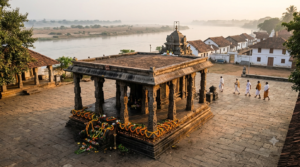
The fourth verse turns to geography. It describes the Brindavana as dark and lustrous like a fresh moonstone, set in the place we now call Mantralaya. The Tungabhadra runs alongside with high, shining waves, and the settlement of learned brahmins surrounds it.
This verse is the reason many devotees say the hymn feels like a pilgrimage in miniature. If you have stood at the Brindavana, the lines land differently.
Beyond time: the seer who knows past and future
A further verse praises Rayaru’s knowledge as unbounded by time. He is aware of what has passed and what is to come, and his greatness exceeds what even great scholars can measure.
The same verse notes that he has conquered the senses. Consequently he protects devotees who keep their thought, word and conduct clean.
The phalastuti: what the closing verse promises
The ninth verse is not part of the eight. It is a phalastuti, a benedictory verse that states the fruit of recitation. It commends chanting the hymn with devotion during the morning and evening sandhya.
Notice what that implies. The composition was intended as a daily practice, not a once-a-week observance.
Where to Find the Correct Text and Audio
Accuracy matters more here than convenience. Transliterations circulating on blogs and forwarded images often carry dropped syllables, broken sandhi and inconsistent spellings, which then get memorised.
The Sri Raghavendra Mangalashtaka deserves that care, since a mispronounced line hardens into habit. The official Sri Raghavendra Swamy Matha maintains a devotional audio library on srsmatha.org with a dedicated Mangalashtaka section. Learn the hymn from that recording, or from a vidwan in your local Matha branch. If you want a printed text, ask at the Matha counter at Mantralaya rather than downloading an unverified PDF.
We do not reproduce the verses here, because a hymn learned from a flawed copy is very hard to unlearn.
When Devotees Chant the Sri Raghavendra Mangalashtaka
Most households chant it immediately after Rayara pooja, since a mangala hymn belongs at the end of worship. Thursday is the customary day, because Thursday is guruvara and associated with the guru.
Many devotees also recite it on Rayaru’s Aradhana days, and through the month of Shravana. During Raghavendra Swamy Aradhana at Mantralaya, the hymn is sung constantly around the Brindavana.
There is no rule restricting it to a single day. As the phalastuti itself indicates, morning and evening recitation is the fuller practice.
A note on health: chanting is a devotional practice, not medical treatment. If you plan to fast, undertake a long journey, or stand in Aradhana queues in peak heat, carry water and any regular medication. Anyone elderly, pregnant, or managing a health condition should consult a doctor before fasting or attempting a strenuous trip.
Mangalashtaka, Stotra or Dandaka? Telling Them Apart
This is where most confusion begins. Appannacharya composed several works for Rayaru, and websites frequently mislabel one as another.
| Composition | Length | Opening words | Where it is used |
|---|---|---|---|
| Mangalashtaka | 8 verses plus phalastuti | Shrimad Rama padaravinda… | Closing of pooja, mangala |
| Raghavendra Stotra | 32 verses plus phalastuti | Sri Poornabodha guru tirtha… | Daily parayana, Thursday recitation |
| Raghavendra Dandaka | Single long prose-verse | Varies by edition | Special parayana and sevas |
The Sri Raghavendra Mangalashtaka is the shortest of the three, so it is also the easiest to memorise. The clearest test is the ending. If every verse closes with the same line asking for auspiciousness, you are reading the Mangalashtaka. If the opening speaks of the ocean of the guru’s teaching, you are reading the Stotra.
Three Errors Devotional Sites Keep Repeating
Correcting these matters, because copied mistakes travel further than accurate ones.
The wrong date. Several widely-copied pages date Appannacharya’s swim across the Tungabhadra to 1761. That cannot be right. Rayaru entered Brindavana at Mantralaya in 1671, so the 1761 figure is a typing error that later pages inherited without checking.
The merged hymns. Many “Mangalashtaka lyrics” pages actually print the Raghavendra Stotra, or splice verses from both. Check the verse count and the repeated closing line before you trust a page.
The Thursday-only claim. Some sites state the hymn must be chanted only on Thursdays. Thursday is customary and much loved, yet the phalastuti points to twice-daily recitation. Treating custom as rule discourages devotees who want a daily practice.
Chanting the Sri Raghavendra Mangalashtaka at Mantralaya
Devotees who chant the hymn at home often want to sing it before the Brindavana. That is entirely possible, though a little planning helps.
Reach the sanctum early, since queues lengthen sharply after mid-morning. Group recitation usually happens in the pradakshina path rather than inside the queue, so step aside once you have had darshan. Learn more about the shrine and the saint in our guide to the life of Sri Raghavendra Swamy and the miracles devotees recount.
One caution deserves repeating. The official Matha has warned that look-alike websites impersonate it to collect payments, so book sevas and rooms only through the official online portal.
Before You Begin Chanting the Sri Raghavendra Mangalashtaka
So learn the Sri Raghavendra Mangalashtaka by ear first. Start with the audio, not the text. Shardula Vikridita is unforgiving, and a wrong syllable length changes the rhythm of the whole line. Once the sound is fixed in memory, the written verses become a reminder rather than a crutch.
Then sit with the meaning for a week before worrying about speed. Because each verse paints a different portrait of Rayaru, the hymn rewards slow attention far more than fast repetition.
Frequently Asked Questions
How many verses does the Sri Raghavendra Mangalashtaka have?
It has eight verses, which is what ashtaka means, followed by a ninth phalastuti verse stating the benefit of recitation. Some printed editions show nine verses for that reason. Both counts describe the same composition.
Who wrote the Sri Raghavendra Mangalashtaka?
Sri Appannacharya wrote it. He was Rayaru’s closest disciple and lived at Bichale, across the Tungabhadra from Mantralaya. He also composed the Raghavendra Stotra and the Raghavendra Dandaka, which remain the most widely chanted Sanskrit hymns for Rayaru.
Is the Sri Raghavendra Mangalashtaka the same as the Raghavendra Stotra?
No, they are separate compositions by the same author. The Mangalashtaka has eight verses and a shared closing line asking for auspiciousness. The Stotra is far longer, opens with the words Sri Poornabodha, and serves as daily parayana rather than a closing mangala.
Can women and children chant it?
Yes. The hymn is a devotional composition in praise of the guru, and households across the Madhwa tradition teach it to children early. No initiation is required, though correct pronunciation is worth learning from a teacher or the Matha recording.
What language is the Mangalashtaka in?
It is in Sanskrit, composed in the Shardula Vikridita metre. Devotees commonly read it in Kannada, Devanagari, Telugu or Tamil script, but the language itself remains Sanskrit in every edition.
Should it be chanted only on Thursdays?
No. Thursday is the customary day because it is guruvara, yet the phalastuti recommends recitation during morning and evening sandhya. Daily chanting is the fuller practice, and many families follow it through Shravana and the Aradhana period.
Where can I hear the correct recitation?
The official Sri Raghavendra Swamy Matha hosts a devotional audio library on srsmatha.org that includes a Mangalashtaka section. Learning from that recording, or from a vidwan at a Matha branch, avoids the pronunciation errors common in forwarded audio clips.
Does chanting the hymn remove problems?
Devotees believe the hymn brings the guru’s grace and steadies the mind, and the tradition frames it that way. These are matters of faith rather than verified outcomes. Chanting should never replace medical treatment, legal advice or professional help when a situation genuinely calls for it.