The Thomas Munro Raghavendra Swamy story is one of the most repeated accounts in South Indian devotional history, so it surprises people to learn that a British record of it genuinely exists. Millions have read how a colonial Collector spoke with a saint who had entered Brindavana more than a century before.
Yet almost every retelling closes with the same citation, and that citation is wrong in three separate ways. The document itself is real, although it is not the document that thousands of websites claim it is.
Independence notice: this website is an independent pilgrim guide, so please read it as one. We are not affiliated with, endorsed by, or the official website of Sri Raghavendra Swamy Mutt, Mantralaya. Also, we accept no bookings, sevas, donations, or payments of any kind. Instead, use the official Mutt website at srsmatha.org for seva booking and official announcements.
The Thomas Munro Raghavendra Swamy Story at a Glance
- The account appears in Madras District Gazetteers: Bellary, Volume I, first compiled by Francis of the Indian Civil Service.
- Specifically, it sits in Chapter XV, the taluk-by-taluk section, under the Adoni taluk entry for Mantsala, on page 213.
- The volume first appeared in 1904, while the widely shared reprint carries the date 1916.
- Notably, Francis credited his own source in a footnote to the Madras Review, Volume VII, page 280.
- The popular citation instead names the “Madras Government Gazette, Chapter XI”, which is a different publication entirely.
So here is the cleanest way to state it. The record is a gazetteer entry and not a gazette notification, because those two words describe completely different kinds of publication.
What the Thomas Munro Raghavendra Swamy Record Actually Says
Page 213 is not a tax order at all. Instead it is a village description, written in the dry house style of colonial reference books.
The entry opens by describing Mantsala, also written as Mantralaya, as a shrothriem village of 1,212 people. The village sits on the Tungabhadra, so it lies in the far north of the Adoni taluk. Francis then notes that it is widely known for containing the tomb of the Madhva saint Sri Raghavendra Swamy.
He records that the August festival drew large numbers of pilgrims. He also lists Lingayats among them, arriving from Bombay, the Nizam’s Dominions and even Mysore. The shrine therefore had a genuinely cross-regional following well over a century ago.
Only after all that does the famous passage appear. Francis introduces it as a quaint story told about the place, since that was his way of flagging local testimony rather than official record. The endowment faced resumption, so Munro came to make enquiries.
He removed his boots and hat, then approached the grave. Then the saint, according to the account, emerged and met him. They discussed the resumption for some time, although the saint stayed invisible and inaudible to everyone else present. Finally Munro returned to his tent and quashed the proposal.
One closing detail of the Thomas Munro Raghavendra Swamy account also rarely survives the retelling. When the Matha offered him consecrated rice, Munro accepted it and directed his kitchen to cook with it that day.
Gazette or Gazetteer: Where the Error Began
A gazette is a periodical of official notices, so it appears in dated and numbered parts. A gazetteer, meanwhile, is a reference book of places arranged into chapters and pages. Because the popular Thomas Munro Raghavendra Swamy citation quotes a chapter and a page, it describes a book rather than a notice.
| Popular claim | What the record shows |
|---|---|
| Madras Government Gazette | Madras District Gazetteers, Bellary Volume I |
| Chapter XI | Chapter XV, the taluk gazetteer section |
| Caption “Manchali Adoni Taluka” | Village entry for Mantsala, Adoni taluk |
| A preserved government order | A story recounted by a compiler in 1904 |
| Page 213 | Page 213, the one detail that is correct |
That last row explains how the mistake spread so widely. Because the page number was accurate, the rest of the citation looked trustworthy and nobody checked it.
Why the 1800 Gazette Claim Cannot Stand
There is also a timing problem, and it is a decisive one. First, the Madras newspaper titled Government Gazette began publication on 15 October 1801. The official Fort St George Gazette started later still, appearing from January 1832 after the Madras government set up its own press in 1831.
Yet Munro took charge of the district in 1800. Therefore no Madras gazette existed that year to carry any notification about Mantralaya. The claim therefore fails on chronology alone, before anyone even opens the volume.
Who Sir Thomas Munro Was
Understanding the Thomas Munro Raghavendra Swamy account needs a little background on the man himself. Munro was born in Glasgow on 27 May 1761, then reached Madras as a young cadet in 1779.
After the fourth Anglo-Mysore war ended in 1799, the Nizam ceded a large territory to the East India Company under the treaty of 1800. Munro then became Principal Collector of these Ceded Districts, which included Bellary and its Adoni taluk. He is remembered as the architect of the ryotwari system, so cultivators paid land revenue directly to the state.
Later he served as Governor of Madras from 1820 until his death. He died of cholera at Pattikonda on 6 July 1827, while touring the very districts he had once settled. At first his grave stood at Gooty. Then in April 1831 the remains travelled to Madras, where they now rest at Saint Mary’s Church inside Fort St George.
That final fact deserves attention, because it quietly resolves another part of the legend. Countless retellings say the order is still preserved in Fort St George. What actually rests at Fort St George is Munro himself.
Four Claims About Thomas Munro Raghavendra Swamy Worth Correcting
- Publication: the real source is the Madras District Gazetteers series, so the Madras Government Gazette citation is simply wrong.
- Chapter: the passage sits in Chapter XV, the place-by-place gazetteer section, so Chapter XI is a misreading.
- Caption: no gazette heading reads “Manchali Adoni Taluka”, because the printed heading is the village name Mantsala inside the Adoni taluk.
- Status: Francis presented the episode as a story and footnoted a magazine article, so he never claimed to reproduce a signed revenue order.
Two smaller errors also travel alongside these. Mantralayam lies in Kurnool district of Andhra Pradesh and not in Telangana, while Sri Raghavendra Swamy entered Brindavana in 1671 rather than 1691.
The Endowment Was Older Than British Rule
The same gazetteer page carries a detail that almost no retelling includes, so it changes how the episode reads.
Francis also notes that one of the Mackenzie Manuscripts attributes the landed endowment to Venkanna Pant. Venkanna Pant served as Dewan to Siddi Masud Khan, while he governed Adoni between 1662 and 1687. The earlier Adoni administration therefore made the grant, long before the Company arrived.
That detail reframes the whole Thomas Munro Raghavendra Swamy encounter. Because Munro was not creating a new grant, he was not gifting land to the Matha either. Instead he was weighing whether to cancel an endowment already standing for well over a century, and he chose to leave it alone.
If you want the wider regional context, our guide to places to visit near Mantralaya also covers Adoni fort and the Raichur country around it.
How to Check the Thomas Munro Raghavendra Swamy Source Yourself
You do not have to take anyone’s word on the Thomas Munro Raghavendra Swamy source, because the volume is out of copyright and freely readable online.
- First, open the scanned volume of the Madras District Gazetteers, Bellary hosted by the Internet Archive.
- Then move to page 213 of the printed text, since it falls inside the final taluk gazetteer chapter.
- Look under the Adoni taluk headings until you reach the entry for Mantsala.
- Read the village description first, since the Munro passage comes only after it.
- Finally, check the footnote at the foot of the passage, because it points to the Madras Review.
For the gazette side of the comparison, the Government of Tamil Nadu still publishes the successor of the Fort St George Gazette through its Department of Stationery and Printing. A short comparison there confirms how different the two formats really are.
What the Thomas Munro Raghavendra Swamy Correction Means for Devotees
The Thomas Munro Raghavendra Swamy correction changes a footnote, so it does not change a faith. Correcting a citation is never the same as denying an experience.
After all, Francis was recording what people in the Adoni taluk told him. He was not verifying a miracle, since a colonial gazetteer was never the right instrument for that anyway. For devotees, then, the encounter belongs to faith and to the Madhwa parampara, not to the revenue archive.
Still, what the record does establish is solid enough on its own terms. A British administrator visited the Brindavana, removed his hat and boots out of respect, then dropped a resumption proposal that his own government wanted pursued. All of that sat in an official reference book by 1904.
You can also read more about the miracles of Sri Raghavendra Swamy as devotees have preserved them.
Seeing the Thomas Munro Raghavendra Swamy Story at Mantralaya
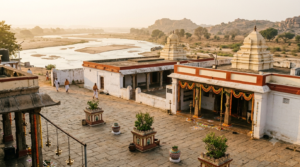
Pilgrims often ask where to stand when they picture the Thomas Munro Raghavendra Swamy scene. The Brindavana that Munro is said to have approached still remains the focal point of the Matha complex.
Our Mantralaya temple and Brindavana guide also explains the layout and the darshan flow. Meanwhile, background on Rayaru’s life sits in our overview of Sri Raghavendra Swamy’s life and history.
A short practical note is worth adding, because the Aradhana period in August draws very heavy crowds. Queues can be long and the Rayalaseema heat is demanding, so carry water and take breaks. Elderly pilgrims and anyone with a medical condition should plan lighter days, and speak to a doctor before fasting.
Before You Share This Story
The Thomas Munro Raghavendra Swamy episode does not need embellishment, since the verifiable version is striking enough. A named colonial officer, a named district, a printed page and a footnote all exist, so anyone can check them today.
Passing on a wrong citation only gives sceptics an easy target, while the correct one survives scrutiny. So when you share the Thomas Munro Raghavendra Swamy story next, cite the Bellary gazetteer, Chapter XV, page 213. That single change also makes the account stronger rather than weaker.
Frequently Asked Questions
Is the Thomas Munro Raghavendra Swamy story recorded in any British document?
Yes, so the account is not a modern invention. It appears in the Madras District Gazetteers volume for Bellary district, first published in 1904. Specifically, the passage sits on page 213 under the Adoni taluk entry for Mantsala. Francis also presented it as a local story rather than as verified fact.
Was the order published in the Madras Government Gazette?
No, because no evidence supports that claim. The Madras newspaper called Government Gazette only began in October 1801, while the official Fort St George Gazette started in 1832. Since Munro took charge in 1800, no such gazette existed then to publish any notification.
What is the difference between a gazette and a gazetteer?
A gazette is a periodical carrying official notices, appointments and orders, so it appears in dated numbered parts. A gazetteer, meanwhile, is a reference book describing the geography, history and settlements of a region. The Bellary record is a gazetteer, so it carries chapters and page numbers.
In which year did the Thomas Munro Raghavendra Swamy meeting take place?
Most accounts place the visit around 1800 or 1801, soon after Munro became Principal Collector of the Ceded Districts. Still, the gazetteer entry does not fix a precise date. So treat any specific day or month quoted online as unverified.
Where is the original order kept today?
No one making the claim has yet produced an original order. The often-repeated line about Fort St George most likely confuses the document with Munro’s grave, because his remains moved to Saint Mary’s Church there in April 1831.
Who originally granted the Mantralaya endowment?
The gazetteer cites one of the Mackenzie Manuscripts, since that source attributes the grant to Venkanna Pant. He served as Dewan to Siddi Masud Khan while that officer governed Adoni between 1662 and 1687. The endowment therefore predates British administration in the region by well over a century.
Does the citation error mean the miracle did not happen?
Not at all, because these are two separate questions. The citation error concerns which book the account appears in, while the encounter itself is a matter of faith and devotional tradition. After all, Francis simply wrote down what residents of the taluk told him.
Where exactly is Mantralayam located?
Mantralayam sits on the Tungabhadra river in Kurnool district of Andhra Pradesh, so it lies close to the Karnataka border. Earlier, under British administration, the village fell within the Adoni taluk of Bellary district. Yet some articles wrongly place it in Telangana.