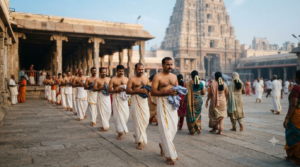
Mantralayam temple dress code rules are simple at first glance, but one detail matters most for men: the official Sri Raghavendra Swamy Matha guidance asks them to remove both shirt and banian while approaching Rayaru’s Brindavana for darshan. Women should wear Indian-style clothing, with traditional dress such as a saree preferred. This guide separates those official instructions from stricter claims repeated on travel websites.
Independence note: srsmatha.org.in is an independent pilgrim guide. It is not affiliated with, endorsed by, or the official website of Sri Raghavendra Swamy Matha, Mantralayam. We take no darshan, seva, room, donation, or payment bookings. Use only srsmatha.org for official services and current instructions.
Mantralayam Temple Dress Code at a Glance
The current official Brundavana guidance gives a clear baseline for ordinary darshan. Men should remove their shirt and banian and hold them in their hands, while women should wear Indian-style clothes and preferably traditional dress. The same page also discourages headgear, cooling glasses, and unsuitable clothing while devotees approach the Brindavana.
| Devotee | Official guidance | Practical reading |
|---|---|---|
| Men | Remove shirt and banian for Brindavana darshan | Keep upper garments easy to remove and carry |
| Women | Wear Indian-style clothing; saree preferred | Choose modest traditional Indian dress |
| Children | No separate child rule appears on the current guidance page | Use modest clothing and follow staff directions |
| Everyone | Avoid headgear, cooling glasses and unsuitable clothing near the Brindavana | Pack simply and keep accessories easy to store |
The most useful correction is this: the official page does not state that every male devotee must wear a dhoti for ordinary Brindavana darshan. It does specifically instruct men to remove the shirt and banian. Therefore, pages that present a dhoti-only rule as the official universal entry condition go beyond the wording now published by the Matha.
What Should Men Wear for Mantralayam Darshan?
Men should arrive in modest clothing and be ready to remove their shirt and banian before Brindavana darshan. The Matha tells men to hold those garments in their hands while obtaining darshan. A dhoti or panche fits the setting well, but the current official Brundavana page does not explicitly say that trousers are banned for ordinary darshan.
If you prefer the least complicated option, wear a dhoti or panche with an upper garment that comes off quickly. However, the Mantralayam temple dress code published by the Matha should take priority over stricter travel-blog claims or old reviews.
Does the Mantralayam Temple Dress Code require a dhoti?
The official rule page reviewed for this guide does not say that a dhoti is compulsory for every man during normal Brindavana darshan. Instead, it clearly says men should remove their shirt and banian and hold them. If you join a particular seva, follow the attire instructions attached to that seva or given by Matha staff.
Many third-party pages merge general darshan customs with seva attire. As a result, pilgrims may think one clothing rule applies everywhere. A specific booking or counter instruction should take priority for that seva.
What Should Women Wear Under the Mantralayam Temple Dress Code?
Women should wear Indian-style clothing, and the Matha specifically says traditional dress such as a saree is preferable. That wording supports modest Indian attire rather than a single compulsory garment for every visitor. Since the official guidance does not publish a detailed list of every allowed outfit, avoid relying on unofficial “allowed versus banned” lists.
A saree is the clearest traditional choice because the official page names it as the preferred example. If your visit includes a seva, check the official booking instructions because ritual participation can carry more specific expectations.
Are jeans, leggings or Western clothes officially banned?
The current Brundavana guidance says devotees should not wear “weird types of clothes,” and it asks women to dress in Indian style. It does not publish a detailed garment-by-garment ban list on that page. Therefore, the safest plan is traditional Indian dress rather than trying to test the edge of an unwritten rule.
Many online guides overstate the evidence by turning custom into a blanket ban. The official wording is narrower, so the Mantralayam temple dress code here follows the source rather than copied lists.
Mantralayam Temple Dress Code for Children and Families
The official Brundavana guidance does not publish a separate child-specific clothing section. Families should therefore dress children modestly and follow any instructions given at the entrance or final darshan area. For boys nearing the Brindavana, parents should be prepared in case staff apply the men’s upper-garment practice.
Families with seniors or young children should keep their hands free and carry only essentials. For a broader plan, see the site’s Mantralaya family trip guide for seniors and children.
Before your first visit, also check the first-time Mantralaya pilgrim checklist. It covers timing, room planning, travel, and what to carry, so the dress rule does not become a last-minute surprise.
Mantralayam Temple Dress Code: Rules Near Rayaru’s Brindavana
Clothing is only one part of the Matha’s published guidance. The same official page places strong emphasis on patience, quiet conduct, and respect for other devotees. These rules matter because the Brindavana queue can bring together families, elderly pilgrims, seva participants, and first-time visitors in the same narrow flow.
- Do not push or shove people in the queue.
- Do not seek out-of-turn darshan or ask someone to help you jump the queue.
- Keep your voice low while approaching the Brindavana.
- Perform pradakshina in the courtyard quietly, as the Matha advises.
- Avoid headgear and cooling glasses during Brindavana darshan.
- Do not eat outside food in the courtyard.
- If you receive coconut as naivedya, do not leave the shell behind.
What Women Should Know About Namaskara and Urulu Seva
The official Matha guidance includes two specific participation rules for women. It says women should not perform Urulu Seva, where a devotee rolls around the courtyard during pradakshina. It also says women should not perform sashtanga namaskara with the whole body touching the floor.
Instead, the guidance asks women to offer namaskara by kneeling. These are religious-house instructions, so follow them even if your family follows a different custom elsewhere. If a priest or authorised volunteer gives a more specific direction during a seva, follow that local instruction.
Do You Need to Visit Manchalamma Before the Brindavana?
The Matha’s own pilgrim guidance recommends bathing in the Tungabhadra and visiting Manchalamma before entering the Matha premises. Many devotees therefore treat Manchalamma as the traditional first stop before Rayaru’s Brindavana. The guidance presents this as part of the pilgrimage sequence rather than a ticketing or booking requirement.
River conditions can change, however, so never treat a Tungabhadra bath as compulsory when the water looks unsafe. Check barriers and local instructions first, especially after heavy rain. The site’s Mantralayam river bath guide explains the traditional sequence and practical river-safety precautions.
Can You Wear Caps, Sunglasses or Other Accessories?
The official guidance specifically discourages headgear and cooling glasses while devotees have darshan of Rayaru. So remove caps, hats, and sunglasses before the final approach unless staff tell you otherwise. If you need prescription eyewear, follow practical necessity and ask a staff member if you are unsure.
Keep accessories minimal because men may already need to hold a removed shirt or banian. A small secure bag is useful, but bulky luggage makes the queue harder to manage.
Are Mobile Phones and Photography Allowed?
The official Brundavana guidance reviewed for this article does not publish a blanket phone or photography rule. Therefore, do not assume that photography is allowed merely because another visitor uses a phone nearby. Follow signs, security instructions, and any restricted-area rules displayed on the day of your visit.
Keep calls quiet and avoid blocking the queue for photos. Since rules can differ by area, on-site instructions should override general travel advice.
Mantralayam Temple Dress Code During Sevas
The Mantralayam temple dress code for ordinary Brindavana darshan should not automatically be treated as the full clothing rule for every seva. The official daily-seva page publishes seva timings and booking information, but the general page reviewed here does not give one universal attire formula for all rituals. Specific sevas may involve added ritual requirements.
Check the details shown during official seva booking, then follow the counter or priest’s instructions when you arrive. This approach prevents a common mistake: arriving in clothing that works for general darshan but not for a closer ritual role. Use only the official Sri Raghavendra Swamy Matha seva information for current arrangements.
Current Darshan Hours and the Evening Timing Conflict
The official Brundavana Darshana page currently lists darshan from 6:00 AM to 2:00 PM and again from 4:00 PM to 9:00 PM. However, the official contact page lists the evening session from 4:00 PM to 8:30 PM. Since both pages belong to the Matha, use 8:30 PM as the safer planning cut-off and recheck before travel.
| Session | Official listing | Planning advice |
|---|---|---|
| Morning | 6:00 AM to 2:00 PM | Arrive well before closing |
| Midday closure | 2:00 PM to 4:00 PM | Use this time for rest or meals |
| Evening | 4:00 PM to 8:30/9:00 PM across two official pages | Treat 8:30 PM as the safer cut-off |
The Matha says pooja timings can change during Aradhana days. Check the official Brundavana Darshana page again near your visit date.
Mantralayam Temple Dress Code: Common Mistakes to Avoid
The biggest mistake is trusting a copied rule without checking what the official Matha actually says. Many pages state a dhoti-only rule for all men, while the current official Brundavana page focuses on removing the shirt and banian for darshan. Another mistake is treating a seva rule, family custom, or old review as a universal entry condition.
- Do not arrive at the final queue with a complicated outfit that is hard to adjust.
- Do not assume sunglasses or caps can stay on near the Brindavana.
- Do not rely on an old forum post for women’s attire or seva participation rules.
- Do not argue with same-day staff instructions because crowd controls can change.
- Do not confuse general darshan guidance with stricter ritual or seva requirements.
The practical goal is not to test the minimum acceptable clothing. Traditional Indian dress keeps the Mantralayam temple dress code simple and removes most uncertainty before the queue.
A Simple Clothing Checklist Before You Leave Your Room
Use this quick check before walking to the Matha because changing plans at the final queue wastes time. Men should make sure their upper garments come off easily, while women should choose modest Indian-style dress. Everyone should leave unnecessary accessories behind or keep them in a small secure bag.
- Men: easy-to-remove shirt and banian; dhoti or panche if you prefer traditional wear.
- Women: Indian-style clothing, with saree as the official page’s preferred example.
- Children: modest, comfortable clothing and simple footwear.
- Accessories: avoid caps and cooling glasses near the Brindavana.
- Queue items: carry as little as possible and keep valuables secure.
- Seva participants: check the official booking instructions before leaving your room.
If you travel with an elderly person, keep essential medicine accessible and sort clothing before joining the main line. Parents with children benefit from the same approach.
What If You Reach the Matha in the Wrong Clothes?
Do not assume that entry or a booked seva is guaranteed if your clothing does not match the instruction given for that area. First, follow the staff direction at the entrance or seva counter. If they ask you to change, return to your room or another appropriate changing place rather than trying to argue your way through.
The safest fallback is simple: keep one traditional outfit ready at your accommodation. That way, a clothing problem is less likely to cost your darshan window.
Before You Go
The Mantralayam temple dress code is best understood from the Matha’s own wording, not from copied lists. Men should remove shirt and banian for Brindavana darshan, while women should wear Indian-style clothing and preferably traditional dress. Devotees should also avoid headgear, cooling glasses, queue jumping, loud behaviour, and outside food in the courtyard.
Check current instructions on the official Sri Raghavendra Swamy Matha website before travel because festival-day arrangements can change. When in doubt, traditional dress makes the Mantralayam temple dress code easier to follow.
Frequently Asked Questions
What is the Mantralayam temple dress code for men?
The official Matha guidance says men should remove their shirt and banian and hold them while obtaining Brindavana darshan. It does not state on that page that a dhoti is compulsory for every ordinary darshan visitor. Traditional wear remains the easiest choice if you want to avoid uncertainty.
What is the Mantralayam temple dress code for women?
The Matha asks women to wear Indian-style clothing and says traditional dress such as a saree is preferable. The current guidance page does not provide a long garment-by-garment allowed list. Therefore, modest traditional Indian wear is the safest choice.
Can men wear pants at Mantralayam?
The current official Brundavana page does not explicitly ban trousers for ordinary darshan. Its clear instruction is that men should remove their shirt and banian while approaching the Brindavana. For a seva, follow the specific booking or priestly instruction because requirements can differ.
Is a saree compulsory for women at Mantralayam?
The official guidance says women should dress in Indian style and preferably wear traditional dress such as a saree. It does not phrase the saree example as the only garment permitted on the page reviewed here. When in doubt, a saree is the clearest traditional option.
Can devotees wear caps or sunglasses near the Brindavana?
The Matha guidance discourages headgear and cooling glasses while devotees have darshan of Rayaru. Remove them before the final approach unless staff advise otherwise. Prescription eyewear is a practical need, so ask staff if you have any doubt.
Are mobile phones or cameras banned inside Mantralayam?
The official Brundavana guidance reviewed for this guide does not publish a blanket phone or photography rule. Follow current signs and security instructions instead of assuming permission. Restricted areas can have different rules from outer courtyards.
Can women perform sashtanga namaskara at the Brindavana?
The official guidance says women should not perform sashtanga namaskara with the whole body touching the floor. Instead, it asks women to offer namaskara by kneeling. The same guidance also says women should not perform Urulu Seva.
Can I take outside food into the Matha courtyard?
The Matha asks devotees not to bring outside eatables and eat them in the courtyard. It also asks pilgrims not to leave coconut shells behind after taking coconut offered as naivedya. Keep the courtyard clean and follow staff directions for food areas.
What time should I plan Brindavana darshan?
The official Darshana page lists 6:00 AM to 2:00 PM and 4:00 PM to 9:00 PM, while the official contact page shows an 8:30 PM evening close. Therefore, 8:30 PM is the safer planning cut-off. Recheck the official website before your visit, especially during Aradhana.