The Raghavendra Moola Mantra is the short eight-syllable chant that Rayaru devotees repeat every day for focus, courage, and peace of mind. Most people know it as three simple words. Its meaning, though, runs far deeper than the sound.
This guide explains that meaning in plain language, and it also covers the Sri Raghavendra Gayatri, because devotees often mix the two up. You will learn what each word carries, how these chants are traditionally recited, and which popular claims online are simply wrong.
Srsmatha.org.in is an independent Mantralaya pilgrim guide. We are not affiliated with, endorsed by, or the official website of Sri Raghavendra Swamy Matha, Mantralaya. We do not take bookings, sevas, donations, or payments. For official matters, please use the mutt’s own portal at srsmatha.org.
Raghavendra Moola Mantra at a Glance
- The core chant is “Om Sri Raghavendraya Namah”, an eight-syllable salutation to Rayaru.
- It simply means “I bow to Sri Raghavendra” — a humble prayer, not a demand.
- The Sri Raghavendra Gayatri is a separate, longer chant with its own structure and purpose.
- Anyone can chant either one, regardless of age, gender, or background.
- No paid “initiation” is needed — both chants are freely available to every devotee.
What Is the Raghavendra Moola Mantra?
A moola mantra is a “root” or seed chant — the most essential prayer linked to a deity or guru. For Rayaru, that root chant is “Om Sri Raghavendraya Namah”. Because it has eight syllables, tradition calls it the Ashtakshara, meaning the eight-lettered mantra.
This form appears inside the famous Raghavendra Stotra, the hymn composed by Rayaru’s disciple Sri Appanacharya. That verse promises that steady, sincere japa of this eight-lettered chant fulfils the devotee’s genuine wishes. So the Raghavendra Moola Mantra is short by design. Its power, devotees believe, lies in repetition with attention, not in length.
The Story Behind the Chant
The best-loved story of the tradition explains why this chant carries such weight. As Rayaru prepared to enter his Brindavana at Mantralaya, his devoted disciple Appanacharya was stranded across the flooded Tungabhadra river.
Desperate to reach his guru in time, Appanacharya rushed into the waters while composing the Raghavendra Stotra aloud. Devotees believe the river parted for him, though he arrived just after the final slab was laid. Because Rayaru is said to have completed the last words himself, the Stotra carries the guru’s own blessing. So the mantra within it is treasured as a chant Rayaru personally approved.
Raghavendra Moola Mantra Meaning, Word by Word
Since the chant is brief, every word carries weight. Here is the plain meaning of each part.
- Om — the primordial sound, chanted at the start of most Sanskrit prayers.
- Sri — an honorific of auspiciousness and grace, also linked to Goddess Lakshmi.
- Raghavendraya — “to Raghavendra”, the dative form of the guru’s name.
- Namah — “I bow” or “my salutations”.
Put together, the mantra means “Om, salutations to Sri Raghavendra.” It is an act of surrender rather than a request. The devotee bows first, and the grace follows. That humility is the heart of the whole chant.
Moola Mantra vs the Popular “Pujyaya” Verse
Here is where confusion creeps in. Many websites label the well-known verse “Pujyaya Raghavendraya” as the moola mantra, yet that is not accurate. The two are different prayers with different roles.
The verse runs: “Pujyaya Raghavendraya, Satya Dharma Ratayacha, Bhajatam Kalpa Vrukshaya, Namatam Kamadhenave.” It is a dhyana shloka — a meditation verse that describes Rayaru. Because it is easy to sing, most devotees learn it first. So people naturally assume it is the root chant, although it is really a praise verse.
Its meaning is beautiful. It salutes Raghavendra as one devoted to truth and dharma, as a wish-granting Kalpavriksha tree for those who sing to him, and as a Kamadhenu, the divine cow, for those who bow to him. Knowing this difference helps you chant each prayer with the right intent.
The Sri Raghavendra Gayatri Mantra
The Gayatri dedicated to Rayaru is longer and follows the classic Gayatri template. The commonly recited form is:
Om Venkatanathaya Vidmahe, Satchidanandaya Dheemahi, Tanno Raghavendra Prachodayat.
Notice the three-part shape shared by every Gayatri-style chant. The first line names the one we meditate upon, the second describes his nature, and the third asks for his guidance. This structure makes the Gayatri a chant of aspiration, while the Moola Mantra is a chant of surrender.
Gayatri meaning, line by line
Each line has a clear job, so the meaning is easy to follow once you break it down.
- Om Venkatanathaya Vidmahe — “We meditate upon Venkatanatha”, Rayaru’s birth name before he became a sanyasi.
- Satchidanandaya Dheemahi — “We contemplate the one who is Sat-Chit-Ananda”, meaning existence, consciousness, and bliss.
- Tanno Raghavendra Prachodayat — “May Raghavendra inspire and awaken our intellect.”
Because the chant names Venkatanatha, it quietly reminds devotees of Rayaru’s human journey. He was a scholar and family man first, and a saint later, as our life history of Sri Raghavendra Swamy explains. That reminder is part of the Gayatri’s charm.
Is the Raghavendra Gayatri a Vedic Mantra?
No, and this correction matters. The Raghavendra Gayatri is a devotional chant built in the Gayatri format, yet it is not part of the Vedas. The original Vedic Gayatri is addressed to Savitru, the sun deity, and it is far older.
Guru Gayatris like this one were composed later so that devotees could honour a specific saint in a familiar rhythm. So calling it “Vedic” is a common but incorrect claim. It takes nothing away from the chant, because devotees value it for devotion, not for a Vedic label.
How Devotees Chant the Raghavendra Moola Mantra
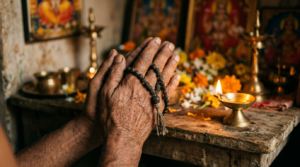
Tradition offers gentle guidance rather than rigid rules. Most devotees chant the Raghavendra Moola Mantra 108 times using a tulsi or rudraksha mala, since 108 is a sacred count in Hindu practice.
Thursday holds special meaning, because it is the day linked to gurus and to Rayaru himself. Many families light a lamp, sit before Rayaru’s image, and chant on Thursday evenings. Early morning is also popular, when the mind is calm and undistracted.
These timings are customs, not conditions. If Thursday or dawn does not suit you, chant when you can. Sincerity matters more than the clock, and Rayaru is believed to respond to genuine feeling above ritual precision.
How to start a simple daily practice
Beginners often overthink the setup, although the practice is meant to be easy. Pick a quiet spot, sit comfortably, and keep Rayaru’s image or a small lamp in front of you.
Take a few slow breaths first, so the mind settles before you begin. Then chant the eight-syllable mantra at a steady, unhurried pace. If your attention wanders, gently return to the sound without frustration. Even five focused minutes each day builds a habit that grows naturally over the weeks.
Common pronunciation mistakes to avoid
Clear sound helps, yet small slips are common and easily fixed. Many new devotees rush the words together, which blurs the meaning.
Say each part clearly — “Om”, then “Sri”, then “Ra-gha-ven-dra-ya”, then “Na-mah”. The name splits into four gentle beats, so slowing down actually helps. Because the chant is short, you have room to pronounce it with care rather than speed. Listening to a trusted recitation once or twice fixes most errors quickly.
A quick comparison of the three chants
| Chant | Form | Main purpose |
|---|---|---|
| Moola Mantra | Om Sri Raghavendraya Namah | Daily surrender and japa |
| Gayatri | Om Venkatanathaya Vidmahe… | Meditation and clear intellect |
| Pujyaya shloka | Pujyaya Raghavendraya… | Praise and description of Rayaru |
Who Can Chant These Mantras?
Anyone can, and that point is worth stressing. Some online posts suggest strict eligibility rules for the Raghavendra Moola Mantra, yet the Rayaru tradition is warmly inclusive. Devotees of every age, gender, and background chant it freely.
You do not need Sanskrit training either. Clear pronunciation helps, so listen to a trusted recitation and follow along slowly. As you grow comfortable, the words settle in on their own. Children often pick up the chant simply by hearing elders repeat it at home.
You Do Not Need to Pay for the Mantra
This warning protects new devotees. Some websites sell “mantra initiation”, paid japa services, or costly yantras while implying the chant only works after payment. That claim is false, and it is worth rejecting firmly.
The Raghavendra Moola Mantra belongs to everyone, and it costs nothing to chant. If a site pressures you to pay before you can pray, treat it as a red flag. For anything official — sevas, donations, or temple queries — always go to the mutt’s genuine portal, never to a third-party middleman.
What Devotees Seek From the Chant
People come to Rayaru with very human worries, and the chant becomes their anchor. Students chant before exams, families chant through health scares, and many simply chant for steadiness in daily life.
The tradition frames these as prayers of trust rather than guaranteed outcomes. Devotees say the repetition calms a racing mind, so decisions feel clearer afterward. Because the words are the same each time, the chant also builds discipline. That quiet regularity, more than any single wish, is what keeps devotees returning to it year after year.
A Gentle Note on Faith and Wellbeing
Devotees turn to Rayaru for comfort during illness, exams, court cases, and hard times, and the miracles of Sri Raghavendra Swamy keep that faith alive. That faith brings real calm and focus, which is a genuine benefit. Still, a chant supports you alongside proper care — it is not a replacement for a doctor, medicine, or professional advice when you truly need them. Chant with devotion, and seek qualified help too.
Before You Begin
The Raghavendra Moola Mantra rewards steadiness far more than perfection. Start with the eight-syllable chant, add the Gayatri when you feel ready, and let the “Pujyaya” verse deepen your understanding of who Rayaru is. Chant simply, chant sincerely, and let the meaning guide the repetition. To plan a temple visit around the year’s biggest festival, see our Raghavendra Swamy Aradhana 2026 guide.
Frequently Asked Questions
What is the Raghavendra Moola Mantra?
It is the eight-syllable root chant “Om Sri Raghavendraya Namah”, which means “salutations to Sri Raghavendra.” Devotees repeat it daily as a prayer of surrender to Rayaru. It appears within the Raghavendra Stotra composed by Sri Appanacharya.
What is the meaning of “Om Sri Raghavendraya Namah”?
It means “Om, I bow to Sri Raghavendra.” Om is the primordial sound, Sri signals auspiciousness, Raghavendraya means “to Raghavendra”, and Namah means “I bow.” Together the words form a humble salutation, not a demand.
Is the Pujyaya Raghavendraya verse the same as the moola mantra?
No. “Pujyaya Raghavendraya” is a dhyana shloka that praises and describes Rayaru. The actual moola mantra is the shorter “Om Sri Raghavendraya Namah.” Many sites confuse the two, though their roles differ.
What does the Sri Raghavendra Gayatri mean?
It means “We meditate upon Venkatanatha, we contemplate the one of pure bliss, may Raghavendra inspire our intellect.” Venkatanatha was Rayaru’s name before he became a sanyasi. The chant follows the standard three-line Gayatri format.
Is the Raghavendra Gayatri a Vedic mantra?
No. It is a devotional chant built in the Gayatri style, but it is not from the Vedas. The original Vedic Gayatri honours the sun deity Savitru. Guru Gayatris like this one were composed later for saints.
When should I chant the Raghavendra Moola Mantra?
Thursday and early morning are traditional favourites, since Thursday is linked to gurus. These are customs, not strict rules. Chant whenever you can focus, because sincerity matters more than the exact time.
Do I need paid initiation to chant it?
No. The chant is free and open to all devotees. Any website charging for “initiation” before you can pray should be treated with caution. Use the official mutt portal for genuine sevas and donations.
How many times should I chant the mantra?
Most devotees chant 108 times using a mala, because 108 is a sacred count. Smaller counts like 9 or 11 are also common for busy days. The number is a helpful habit, not a rigid requirement.