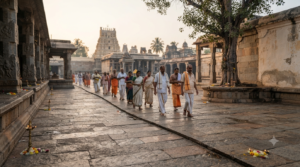
Raghavendra Swamy pradakshina at Mantralaya is the quiet act of walking around the Brindavana courtyard before darshan, keeping Rayaru at the centre of attention. The official Sri Raghavendra Swamy Matha guidance specifically asks devotees to perform pradakshina silently, as much as they can, before approaching the Moola Brindavana. That wording matters because it puts devotion, patience and capacity ahead of a fixed number of rounds.
Independence note: srsmatha.org.in is an independent Mantralaya pilgrim guide. It is not affiliated with, endorsed by, or the official website of Sri Raghavendra Swamy Matha, Mantralayam. We take no darshan, seva, room, donation or payment bookings; use the official Matha website for official information and services.
Raghavendra Swamy Pradakshina at Mantralaya: Quick Meaning
Raghavendra Swamy pradakshina is a devotional circumambulation around the Brindavana precinct. In simple terms, the devotee walks around the sacred centre with attention and reverence before darshan. At Mantralaya, the Matha itself recommends this practice, so it is not merely a custom copied from travel blogs.
- Where: in the Brindavana courtyard or designated pradakshina path inside the Matha precinct.
- When: the official guidance places it before Brindavana darshan.
- How: quietly, without obstructing others, and according to the on-site flow.
- How many rounds: the current official guidance gives no fixed minimum; it says to do as much as you can.
- What to chant: a known shloka, or simply “Sri Raghavendraya namaha” in a low voice.
- What it means: devotees use the walk to steady the mind, honour the guru and prepare for darshan.
Why Brindavana Pradakshina Has Special Significance
The significance begins with what the Brindavana means in Rayaru tradition. Sri Raghavendra Tirtha entered Brindavana at Manchale in 1671, according to the Matha’s traditional account. Devotees therefore approach the Moola Brindavana as the continuing spiritual presence of their guru, not as an ordinary historical monument.
That belief changes the character of pradakshina. The walk is not sightseeing around a memorial. Instead, devotees treat each circuit as an act of guru-seva, remembrance and surrender. The body keeps moving while the mind repeatedly returns to one sacred centre.
This is also consistent with Rayaru’s own devotional life. The official Matha biography describes him visiting Sri Vijayeendra Tirtha’s Brindavana and performing pradakshina with deep devotion. For followers of the Madhwa tradition, that makes circumambulation part of a wider guru-parampara practice rather than a modern invention.
What the Official Matha Actually Says
The most useful correction is simple: the official Brundavana Darshana guidance does not prescribe 11, 21, 48 or 108 rounds for ordinary visitors. It tells devotees to perform pradakshina in the courtyard silently and “as much as you can” before darshan. Therefore, a fixed count should not be presented as a universal entry rule.
| Question | Official guidance | Practical meaning |
|---|---|---|
| When to do it? | Before Brindavana darshan | Use it as a calm preparation for darshan |
| How many rounds? | As much as you can | No universal fixed minimum is stated |
| How loudly? | Silently or with a low voice | Do not disturb the courtyard or queue |
| What may I chant? | Known shlokas or “Sri Raghavendraya namaha” | Keep the chant simple if you are unsure |
| Can I rush? | Do not push or seek out-of-turn darshan | Pradakshina should not become a race |
How to Perform Raghavendra Swamy Pradakshina at Mantralaya
Raghavendra Swamy pradakshina needs no special online booking, payment or separate ticket. It is part of a devotee’s conduct in the courtyard. Follow staff directions first, because crowd-control routes can change on Thursdays, Aradhana days and other busy periods.
- Enter with a settled pace. Finish footwear and basic preparations before joining the inner flow, so you do not stop suddenly in the courtyard.
- Follow the marked or natural path. Move with other devotees and never cut across a queue or restricted area.
- Keep Rayaru in mind. You may chant softly, remember a verse, or walk in silence.
- Do only a comfortable number. The Matha says “as much as you can,” so age, health and crowd conditions matter.
- Complete the circuit without haste. Avoid counting so aggressively that you lose awareness of people around you.
- Then proceed for darshan. Keep your voice low and move patiently with the queue.
If you are new to Mantralaya, also read the site’s Mantralayam dress code and courtyard rules. They matter near the Brindavana because the final darshan area follows traditional conduct.
Why Raghavendra Swamy Pradakshina Comes Before Darshan
Placing pradakshina before darshan creates a useful transition. A pilgrim may arrive after a train ride, hotel check-in, crowded street or long queue. Walking a few quiet rounds slows that momentum and gives the mind one clear focus before the brief moment of darshan.
This sequence also shifts attention away from “getting through” the visit. Instead of treating the Brindavana as the final stop on a checklist, the devotee spends time in its orbit first. That difference is small in logistics but large in experience.
The official guidance reinforces the same mood. It asks devotees not to push, shout or seek out-of-turn darshan. Therefore, pradakshina and queue discipline belong to one idea: approaching Rayaru without making another devotee’s worship harder.
Raghavendra Swamy Pradakshina: Counts, Chants and Common Confusion
Raghavendra Swamy pradakshina at the Moola Brindavana should not be confused with a home vratam or a personal sankalpa seva. Some household observances use set counts such as 11 rounds. That does not turn the same number into a compulsory rule for every pilgrim walking in the Mantralaya courtyard.
The cleanest rule is the official one: do what you can, quietly. If you have taken a personal sankalpa with a priest or family tradition, follow that vow only when it remains compatible with Matha instructions and crowd movement. Never block the path to complete a private count.
For chanting, the Matha gives an unusually simple fallback. If you do not know a shloka, you may repeat “Sri Raghavendraya namaha” with devotion. Devotees who want the fuller wording can read this guide to the Poojyaya Raghavendraya mantra.
What Sri Raghavendra Tantra Says About Pradakshina
A later devotional work known as Sri Raghavendra Tantra, attributed to Sri Krishnavadhuta, gives pradakshina an especially exalted meaning. A verse commonly cited from that work compares one heartfelt circuit around the guru with the merit of a vast sacred pilgrimage. Devotees often quote this idea as “sakala yatra phala,” the fruit of many pilgrimages.
That should be read as a devotional promise within tradition, not as a measurable or guaranteed outcome. The point is not that walking a circle replaces ethics, prayer or personal responsibility. Rather, the verse magnifies the value of wholehearted guru-bhakti concentrated in a simple act.
This distinction keeps the practice grounded. Faith traditions may describe spiritual merit in powerful language, while the pilgrim still has to walk gently, respect others and accept that no ritual guarantees a worldly result.
Ordinary Pradakshina Is Not the Same as Urulu Seva
Another common mix-up involves Urulu Seva. Ordinary pradakshina means walking around the sacred centre. Urulu Seva is a different austerity in which a devotee rolls around the courtyard, and the official Matha guidance specifically says women should not perform that form of seva.
That restriction should not be misread as a ban on women doing ordinary walking pradakshina. The published page itself tells devotees generally to perform pradakshina before darshan, then separately addresses Urulu Seva. When staff issue local instructions, those on-site directions should always take priority.
For most visitors, walking pradakshina is the relevant practice. It is simpler, safer and fully aligned with the official wording.
The Deeper Meaning: Centre, Repetition and Guru-Bhakti
Pradakshina works through a physical idea that is easy to understand. The sacred presence stays at the centre, while the devotee moves around it. Symbolically, that reverses the ordinary habit of placing one’s own plans and worries at the centre of everything.
Repetition adds a second layer. One round may feel like movement. Several unhurried rounds can become a rhythm of attention, especially when paired with a short name or shloka. The value lies less in arithmetic and more in returning the mind each time it wanders.
For Rayaru devotees, the guru is also a guide toward Sri Hari within the Dvaita tradition. So the circle is not meant to end in personality worship alone. Its devotional logic points through the guru toward dharma, humility and remembrance of God.
Practical Etiquette Most First-Time Visitors Miss
The best pradakshina is one that does not inconvenience another pilgrim. For first-time pilgrims, Raghavendra Swamy pradakshina works best when the pace stays calm and the path stays clear. If the courtyard becomes congested, fewer calm rounds are better than forcing a large count.
- Do not stop in a narrow passage to finish a mantra or count.
- Keep phones away unless photography is clearly permitted in that area.
- Do not use loud group chanting near the final darshan queue.
- Follow dress and upper-garment instructions before approaching the Brindavana.
- Do not combine pradakshina with queue-jumping or requests for special access.
- If staff redirect the route, follow them even if it changes your usual pattern.
Devotees who want the historical background behind the shrine can read the site’s account of Sri Raghavendra Swamy’s Brindavana Pravesha. It explains why the Brindavana holds a living devotional meaning for followers.
Safety and Accessibility During Pradakshina
Raghavendra Swamy pradakshina should not become a test of stamina. The official phrase “as much as you can” leaves room for age, disability, illness, heat and crowd pressure. A senior devotee who walks one careful round has no reason to imitate another person’s large sankalpa count.
If you use a walking aid, move slowly and follow volunteers if they offer a safer route. During hot weather, stay hydrated outside restricted sacred areas and avoid pushing yourself to dizziness. Anyone with a medical condition should prioritise health over a self-imposed ritual target.
The same principle applies to children. Keep them close, avoid rush periods when possible, and do not make them run rounds for the sake of a number.
Timing Raghavendra Swamy Pradakshina Without Rushing
The official Brundavana Darshana page currently lists darshan from 6:00 AM to 2:00 PM and again from 4:00 PM to 9:00 PM. However, the official contact page lists the evening close as 8:30 PM. Because the Matha also warns that schedules vary during major events, plan conservatively and check the official portal on the day of your visit.
For pradakshina, arriving well before the final closing period is more useful than chasing the last possible minute. You need enough space to walk calmly and then join darshan without anxiety. On Thursdays and festival days, crowd movement may limit how long you can remain in the courtyard.
Mistakes That Reduce the Meaning of the Practice
The first mistake is turning pradakshina into a numbers contest. A second is treating a personal vow as a universal rule. Both errors shift attention from devotion toward performance.
Another mistake is chanting loudly enough to dominate the space. The official guidance specifically asks for silence or a low voice near the Brindavana. Likewise, pushing ahead after finishing your rounds defeats the spirit of the practice because it places your urgency above another devotee’s turn.
Finally, do not treat spiritual “benefits” as guarantees. Devotees may pray for health, family peace, work, study or relief from difficulties. Those hopes belong to faith, while practical decisions still need ordinary effort, professional advice where relevant and patience.
Before You Approach the Brindavana
Raghavendra Swamy pradakshina at Mantralaya is meaningful precisely because it is simple. Walk quietly, keep Rayaru at the centre of your attention and do only what your body and the crowd allow. Then enter the darshan queue with the same patience you practiced during the rounds.
The most important correction is worth remembering: the official Matha does not require a universal fixed number for ordinary courtyard pradakshina. It asks devotees to perform it silently, as much as they can. That instruction protects both the devotional purpose and the dignity of everyone sharing the space.
Frequently Asked Questions
How many Raghavendra Swamy pradakshina rounds should I do at Mantralaya?
The current official Matha guidance does not state a fixed number for ordinary courtyard pradakshina. It says to perform pradakshina silently “as much as you can” before darshan. Personal sankalpa counts may differ, but they should not obstruct other devotees.
Should I do pradakshina before or after Rayaru darshan?
The official Brundavana Darshana page places pradakshina before darshan. In practice, walk the designated courtyard route first and then proceed with the darshan flow. On busy days, follow staff directions because access routes can change.
What should I chant during Brindavana pradakshina?
You may recite a shloka you know or simply chant “Sri Raghavendraya namaha” in a low voice. The official Matha specifically offers that simple name as an option. Silence is also appropriate when the courtyard is crowded.
Is 11 pradakshina compulsory at the Mantralaya Brindavana?
No universal 11-round rule appears in the current official guidance for ordinary visitors. The number 11 is associated with some home vratam or personal sankalpa traditions, which is a different context. At Mantralaya, the published instruction is to do as much as you can.
Can women perform pradakshina at Mantralaya?
The official guidance generally asks devotees to perform pradakshina before darshan and does not ban women from ordinary walking pradakshina. It separately says women should not perform Urulu Seva, the rolling form of circumambulation. Follow any current on-site instructions.
What is the spiritual benefit of Raghavendra Swamy pradakshina?
Devotees regard the practice as guru-seva, prayer and a way to steady the mind before darshan. Sri Raghavendra Tantra uses very elevated language for its spiritual merit, but such benefits belong to devotional belief. They should not be treated as guaranteed worldly outcomes.
Do I need a ticket or booking for pradakshina?
Ordinary pradakshina in the Brindavana courtyard is not presented by the Matha as a separately booked service. Follow the normal darshan route and current on-site instructions. Any paid seva should be arranged only through the official Sri Raghavendra Swamy Matha channels.
Can elderly devotees do fewer rounds?
Yes. The official wording itself says to perform pradakshina as much as you can, so capacity matters. Seniors and anyone with mobility or health limits should choose a safe number and never strain simply to match someone else’s count.