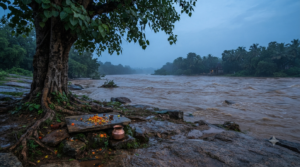
Appanacharya was not at Mantralaya on the day his guru entered the Brindavana. He stood on the far bank of the Tungabhadra, and the river ran in flood. What he sang while crossing it became the most recited hymn in the Madhwa world. Yet its final three words, tradition holds, were never his.
This site is an independent pilgrim guide. We are not affiliated with, endorsed by, or the official website of Sri Raghavendra Swamy Mutt, Mantralayam, and we take no bookings, sevas, or donations. For seva booking, room reservation and official announcements, please use the official Matha portal.
Appanacharya at a Glance
- Who: Madhwa scholar, landowner and gurukula teacher of Bichale, Raichur district, Karnataka.
- Best known for: composing the Sri Raghavendra Stotra, the 32-shloka hymn recited daily by devotees worldwide.
- The famous line: the closing words sakshi hayasyotra hi, which tradition says came from inside the Brindavana.
- Where to visit: Bichale, roughly 20 km by road from Mantralaya, on the same Tungabhadra river.
- Relationship to Rayaru: host, friend and disciple for well over a decade before 1671.
Who Was Appanacharya of Bichale?
Appanacharya was a Madhwa scholar and landholder of Bichale, a riverside village in Raichur taluk of Karnataka. He hosted Sri Raghavendra Swamy for more than a decade, ran a free residential school on the riverbank, and composed the hymn now called the Sri Raghavendra Stotra. Devotees group him with Narayanacharya and Krishnavadhoota as the three great bhaktas of the tradition.
His father, Ramasubbanacharya, was a wealthy jagirdar. Village accounts describe holdings of twenty villages and around three hundred acres of fertile land. Appanacharya inherited that wealth, so he never needed patronage from anyone.
That detail matters, because it changes how you read the friendship. He was not a poor student attaching himself to a famous saint. He was a rich, learned householder who chose to spend his fortune feeding students and his years serving one guru.
The Bichale House Where Rayaru Lived
Bichale carries several older names — Bhikshalaya, Gillesugur and Japada Katte among them. Locals also call it Anu Mantralaya, or the little Mantralaya. Sri Raghavendra Swamy came here from Adoni, and Appanacharya received him into his own home.
Rayaru stayed in that house for years, performing daily pooja of Sri Moola Rama in the central hall. Appanacharya cooked for the deity and for his guru personally, although servants were available. Sources differ on the length of the stay: many put it at twelve years, while the Bichali village record says thirteen.
The house survives, though the 2009 Tungabhadra floods damaged it badly and it was rebuilt afterwards. Pilgrims are still shown the spot where Rayaru performed pooja and the corner where he slept.
Japada Katte and the Gurukula
On the riverbank stood an ashwattha tree, and under it Appanacharya ran an open-air gurukula. Students went house to house collecting rice, which is why the village earned the name Bhikshalaya, the house of alms. The teaching platform is still called Japada Katte.
Rayaru and Appanacharya spent long hours there discussing Vedanta. Tradition holds that Rayaru composed part of his final work at this spot. Pleased with the school, he gifted twelve acres near Kaldakuntla to his host, who initially refused the land because he was already wealthy.
How Appanacharya Composed the Sri Raghavendra Stotra
In 1671, on Shravana Bahula Dwitiya of the Virodhikrit year, Rayaru chose to enter the Brindavana alive at Manchale, now Mantralaya. He knew his closest friend would never permit it, so he sent Appanacharya away on an errand and entrusted the arrangements to Diwan Venkanna.
Appanacharya realised what was happening and turned back at once. When he reached the Tungabhadra, the river was in full spate and no boat would cross. He began to sing instead, and the hymn that poured out started with the words Sri Poornabodha Gurutirtha Payobdhi Para.
Devotees hold that the waters parted and let him through. Whether you read that as history or as sacred memory, the hymn itself is real, and it was composed on the move.
The Three Words Appanacharya Could Not Say
He arrived after the final slab had been lowered onto the Brindavana. The hymn was almost finished, but grief closed his throat. He stopped after the line ending kirtir digvidita vibhutir atula, and could go no further.
Then, tradition records, a voice from inside the sealed Brindavana supplied the ending: sakshi hayasyotra hi. Devotees present recognised it as Rayaru’s own voice. Because of that moment, this is remembered as the first miracle Rayaru performed after entering the Brindavana.
What Sakshi Hayasyotra Hi Actually Means
The phrase means that Lord Hayagriva is the witness here. Rayaru worshipped Hayagriva, the horse-faced form of Vishnu associated with knowledge, and had been chanting the Hayagriva mantra. So the closing words are not decoration. They are a guarantee attached to every promise the hymn makes.
Read the hymn’s later verses and the point becomes obvious. They promise relief from illness, speech for the mute, sight for the blind, and long life to sincere reciters. Those are extraordinary claims, and the closing line names a divine witness to them.
Devotees therefore treat the Sri Raghavendra Stotra as a siddhi stotra, a hymn whose fruit is already vouched for. That is a matter of faith and tradition rather than a medical or scientific claim, and it should be understood in that spirit.
Five Myths About Appanacharya, Corrected
Most pages about Appanacharya copy the same handful of errors from one another. Several of them appear even in widely trusted reference entries. Here is what the sources actually support.
| Commonly repeated claim | What the sources show |
|---|---|
| The stotra begins with “Poojyaya Raghavendraya” | It opens with “Sri Poornabodha Gurutirtha Payobdhi Para”. The Poojyaya verse is the closing shloka, which is simply quoted far more often on its own. |
| Appanacharya wrote the Raghavendra Vijaya | That biography was written by Narayanacharya, described in Matha tradition as Rayaru’s nephew. Two different devotees, two different works. |
| He crossed the Krishna river | Bichale and Mantralaya both sit on the Tungabhadra. The crossing was of the Tungabhadra. |
| Rayaru dictated the whole hymn | Tradition credits Appanacharya with the composition and Rayaru with only the final three words. |
| The hymn has 34 verses | Standard editions count 32 shlokas. Printed versions differ because some number the closing and colophon verses separately. |
The first error is the most stubborn one. Even the Wikipedia entry on Bichali states that the hymn begins with the Poojyaya verse, although the separate entry on the Raghavendra stotra gives the 32-shloka count correctly. If you are chanting from a printed book, check the first line before you trust an online summary.
What Appanacharya Wrote, and What He Did Not
Tradition attributes several devotional works to Appanacharya beyond the main hymn, including the Mangalashtaka, the Kavacha, the Dandaka and the Karavalamba Stotra. Attribution for these is traditional rather than documentary, and reputable Madhwa sources are not unanimous. We flag that openly instead of presenting a tidy list as settled fact.
The Sri Raghavendra Stotra itself is different. Its own closing verse names the author, so the attribution is internal to the text. If you want the verse-by-verse sense, our guide to the Poojyaya Raghavendraya mantra covers the most quoted shloka in detail.
One more distinction is worth keeping straight. Rayaru’s own literary output was philosophical — commentaries, tikas and khandarthas in Sanskrit. Appanacharya’s contribution was devotional poetry about Rayaru, which is why the two bodies of work rarely overlap.
Life After 1671: What Appanacharya Did Next
He did not stop visiting. Accounts say he walked to the Brindavana daily and sat with it, as though the friendship had simply changed form. Rayaru is said to have appeared in his dream and asked him to build a Brindavana at Japada Katte instead.
Appanacharya built it, and that Ekashila Brindavana — carved from a single stone — is the first raised outside Mantralaya. It still stands at Bichale. Several accounts place his own passing at Bichale a few years later, with 1674 the year most often given, though we could not confirm that date against a primary record.
His descendants continue the daily pooja at the house. Haridasa saints from Vijaya Dasa to Jagannatha Dasa visited Bichale and sang about the friendship, which is how much of the oral record survived at all.
Visiting Bichale: The Village Appanacharya Built
Bichale sits about 20 km from Mantralaya by road, although published figures range from 14 km to 22 km depending on the route taken. Mantralaya lies in Kurnool district of Andhra Pradesh, while Bichale is in Karnataka. You cross a state border for a twenty-minute drive.
Shared autos, jeeps and taxis run from Mantralaya, and most pilgrims combine the trip with the Panchamukhi Anjaneya shrine. Roads beyond the bridge have historically been rough, so allow more time than the distance suggests. Our guide to places to visit near Mantralaya maps the wider circuit.
What You Can Actually See There
- The rebuilt house where Rayaru stayed, including the pooja hall.
- Japada Katte, the riverbank teaching platform.
- The Ekashila Brindavana raised by Appanacharya.
- The Hanuman and Ugra Narasimha shrines at the river spot.
- Nagakatti, worshipped especially during Naga Panchami.
If the Trip Does Not Go to Plan
Nothing about Bichale is guaranteed on a given day. It is a small village, it is flood-prone, and it has no ticketing system, published darshan schedule or booking channel. Timings depend on the family conducting the pooja.
So plan around three realistic problems. During the Aradhana rush, transport from Mantralaya gets scarce and slow, and the sensible fallback is an early morning start before the crowd builds. In monsoon, the Tungabhadra can rise and access can close entirely, in which case Mantralaya itself remains open and the trip is better postponed. If you arrive and the house is shut, wait rather than leave, because it usually reopens after the pooja hour.
A short safety note is worth adding. Summers in Raichur district are severe, the riverbank is uneven, and there is little shade at Japada Katte. Carry water, wear proper footwear, and if you are elderly, pregnant or managing a health condition, ask your doctor before combining a fasting day with a long temple circuit.
Timing Your Visit Around the Aradhana
The Aradhana marks the anniversary of Rayaru’s Brindavana Pravesha, so it is the most meaningful window for anyone drawn to the Appanacharya story. The official Matha has announced the 355th Aradhana Mahotsava at Mantralaya from 27 August to 2 September 2026. Bichale sees heavy footfall across those days.
Crowds are the trade-off. If quiet matters more to you than atmosphere, choose an ordinary weekday instead, ideally outside monsoon. Our Raghavendra Swamy Aradhana 2026 guide covers the schedule, and dates should always be reconfirmed on the official portal before you book travel.
What Devotees Get Wrong About the Appanacharya Story
The story is usually told as a race against time, which flattens it. Three details change the reading, and none of them appear in the popular retellings.
First, Appanacharya was reportedly the elder of the two, older than Rayaru by a couple of years. The relationship was therefore not a young disciple following an old master. It was friendship between contemporaries, with the discipleship chosen freely.
Second, his family belonged to the Uttaradi Matha lineage, yet his devotion went to Rayaru of the Mantralaya line. Sectarian boundaries mattered less to him than the guru in front of him. That is unusual enough to be worth stating plainly.
Third, the hymn was not a planned literary project. It was composed while running, on a riverbank, by a man who had just learned he would never see his friend again. Its unpolished urgency is the point, not a flaw.
Before You Chant
The Appanacharya story is, at heart, about what devotion produces under pressure. A wealthy scholar fed students for decades, hosted a saint, then lost him and answered with a hymn instead of silence. Millions still recite that hymn every morning.
If you want to engage with it properly, start with the meaning rather than the speed. Read a reliable printed text, learn what the verses actually promise, and understand the closing line as the witness clause it is. Our explainer on Raghavendra Stotra benefits and our account of Rayaru’s life and miracles together give the full context.
Appanacharya FAQs
Who was Appanacharya?
Appanacharya was a Madhwa scholar and wealthy landholder of Bichale in Raichur district, Karnataka. He hosted Sri Raghavendra Swamy in his home for over a decade and ran a free gurukula on the Tungabhadra bank. He composed the Sri Raghavendra Stotra in 1671.
Who wrote the Sri Raghavendra Stotra?
Appanacharya of Bichale wrote it. The hymn’s own closing verse names him as the author. Tradition holds that only the last three words, sakshi hayasyotra hi, came from Rayaru inside the Brindavana.
What does sakshi hayasyotra hi mean?
It means that Lord Hayagriva is the witness here. Hayagriva is the horse-faced form of Vishnu linked with knowledge, and Rayaru was devoted to him. The line functions as a divine guarantee for the promises made earlier in the hymn.
How many verses does the Sri Raghavendra Stotra have?
Standard editions count 32 shlokas. Some printed and online versions list 33 or 34 because they number the closing and colophon verses separately. Check the edition you are chanting from rather than an online count.
Where is Bichale, and how far is it from Mantralaya?
Bichale, also spelled Bichali or Bichchali, is a village in Raichur taluk of Karnataka on the Tungabhadra river. It lies roughly 20 km by road from Mantralaya, though published figures vary from 14 km to 22 km. Autos and taxis run from Mantralaya.
Did Appanacharya write the Raghavendra Vijaya?
No. The Raghavendra Vijaya was composed by Narayanacharya, described in Matha tradition as Rayaru’s nephew. The confusion arises because both men are counted among the great devotees of Rayaru.
How long did Rayaru stay at Appanacharya’s house?
Accounts differ. Many sources say twelve years, while the Bichali village record says thirteen. Either way, the stay ended when Rayaru moved to Manchale to enter the Brindavana.
Can I book a room or seva at Bichale online?
Bichale is a village shrine complex, not a booking-based temple, and it has no online reservation system. Accommodation is normally taken at Mantralaya, where the official Matha runs its own guesthouses and seva counters. Book only through the official Matha website, since fake portals are a known problem.
What is Japada Katte?
Japada Katte is the riverbank platform at Bichale where Appanacharya taught his students and where he and Rayaru discussed Vedanta for years. The name refers to the japa, or repeated chanting, performed there. It remains the focal point of a Bichale visit.