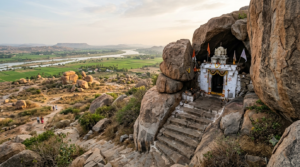
The Panchamukhi Anjaneya Temple Mantralaya sits across the Tungabhadra River, not inside the town at all. It stands on a rocky hillock in Karnataka’s Raichur district. Many travel pages wrongly place it “in Mantralaya, Andhra Pradesh”, so first-time pilgrims often look in the wrong direction.
This quiet cave is where Sri Raghavendra Swamy meditated for twelve years. Here, devotees believe, Lord Hanuman revealed his rare five-faced form. If you are visiting Rayaru’s Brindavana, this river crossing completes the yatra, though most guides barely explain how to do it.
srsmatha.org.in is an independent Mantralaya pilgrim guide. We are not affiliated with the official Sri Raghavendra Swamy Matha, nor endorsed by it. We take no bookings, donations, or payments. For any reservation or ritual booking, use the official Matha and the temple authorities directly.
Panchamukhi Anjaneya Temple Mantralaya at a glance
- Where: Panchamukhi near Ganadhal, Raichur district, Karnataka, across the Tungabhadra from Mantralaya.
- Distance: about 20–25 km by road, or a short coracle crossing when the river is low.
- Why it matters: Rayaru did penance here for roughly twelve years before settling in Mantralaya.
- The deity: a self-manifested five-faced Hanuman, carved into the cave rock, seated and facing east.
- Terrain: a cave shrine on a hillock, reached by a short climb up rock steps.
- Don’t miss: the nearby Yerakalamma Devi shrine, traditionally visited along with the main temple.
Where is Panchamukhi Anjaneya Temple near Mantralaya?
The Panchamukhi Anjaneya Temple Mantralaya stands in Panchamukhi, close to Ganadhal village. That village lies in Raichur district of Karnataka. The shrine sits on the northern bank of the Tungabhadra.
Mantralaya, meanwhile, sits on the southern bank in Kurnool district of Andhra Pradesh. So the two places share one pilgrimage across two states.
This detail matters for planning. Several aggregator pages wrongly list the shrine “within Mantralaya town”. In truth, you must cross the river to reach it.
By road the trip runs about 20–25 km over the Tungabhadra bridge, since the road loops around to the crossing. The postal address falls under Panchamukhi, Raichur, Karnataka, pincode 584140. So everything about the Panchamukhi Anjaneya Temple Mantralaya begins with that one river crossing.
The story behind Panchamukhi Anjaneya Temple Mantralaya
Long before Mantralaya became a great centre, this cave was Rayaru’s place of tapas. Tradition holds that Sri Raghavendra Swamy worshipped Lord Rama here daily. He then meditated deeply for about twelve years, around the 16th to 17th century.
During that time, devotees believe, he carved images of Lord Venkateswara and Goddess Lakshmi onto the cave rock. Because of this penance, the site became sacred long before the town rose to fame.
Pleased by that devotion, Lord Anjaneya is believed to have appeared before him. He took the Panchamukha, or five-faced, form. Because the shrine ties to that vision, Madhwa devotees treat it as part of the Mantralaya yatra. Tradition also says Kolhapur Mahalakshmi, Venkateswara, and Vishnu as Varaha gave darshan here.
Who discovered the self-manifested idol?
The idol here is swayambhu, meaning self-manifested rather than sculpted. Local tradition credits its discovery to a devout Madhwa brahmin named Anantachar. One night, Panchamukhi Hanuman is said to have appeared in his dream.
The next day, a mysterious brahmin guided him to the hidden murti in the forest. Since then, his descendants have served as head priests, generation after generation.
The Ramayana legend of the five faces
The five-faced form itself goes back to the Ramayana. Ahiravana, the ruler of Patala, once abducted Rama and Lakshmana. So Hanuman followed into the netherworld to rescue them.
To kill Ahiravana, he had to snuff out five lamps at once. Because each lamp burned in a different direction, no single face could do it.
So Hanuman took on five faces together, each an aspect of Lord Vishnu. He then extinguished all five flames at the same moment. That act is the mythological root of the form worshipped here. Because of it, devotees see this shrine as a place of protection and courage.
What the five faces of Panchamukha Hanuman mean
Each face points in a direction and carries its own meaning. These associations are matters of faith and Vedic tradition. They are not verified fact, yet they still shape how devotees pray here.
| Direction | Face | Traditionally sought |
|---|---|---|
| East | Sri Anjaneya (Hanuman) | Devotion, courage, fulfilment of wishes |
| South | Ugra Narasimha | Protection and freedom from fear |
| West | Mahaveera Garuda | Relief from troubles and negative influences |
| North | Lakshmi Varaha | Prosperity and well-being |
| Upward | Hayagriva | Knowledge, learning, and clarity |
The east-facing Hanuman is the main object of worship, since that is how Rayaru is believed to have received darshan. Because the idol is swayambhu and carved in rock, it looks simpler and older than the tall statues elsewhere.
Darshan timings at Panchamukhi Anjaneya Temple Mantralaya
The darshan timings are not officially published, so treat any figure as indicative. The shrine generally opens in the early morning, then closes for a midday break. After that, it reopens through the evening.
Reported windows cluster around 6 AM to 1–2 PM, and again from about 3–4 PM to 8 PM. Because these hours can shift, confirm them locally or at the Mantralaya Matha before you travel.
Inside the Panchamukhi Anjaneya Temple Mantralaya, the deity appears as a five-faced figure seated on the rock. That posture is rare, since most Hanuman idols stand or stride. There is no online booking and no ticket for regular darshan.
So you simply join the queue on arrival. Dress modestly in traditional attire, and follow the priests’ instructions at the sanctum, since some local shrines ask men to remove upper garments.
How to reach Panchamukhi Anjaneya Temple from Mantralaya
Almost everyone reaches the Panchamukhi Anjaneya Temple Mantralaya from the town itself. So plan Mantralaya first, and treat Panchamukhi as a half-day side trip. You can go by shared auto, private taxi, or bus. There is also a river crossing option when the water is low.
| Option | How it works | Good to know |
|---|---|---|
| Shared auto | Autos run from Mantralaya through the day | Cheapest per head; fares change, so confirm first |
| Private taxi | Hire for a round trip, often with Bichali | Most flexible; best for families and elders |
| Bus | Mantralaya buses toward Raichur or Manvi pass here | Frequency varies; check the return timing |
| Coracle | Cross the Tungabhadra, then a short local ride | Scenic but seasonal; skip it in high water |
By road the drive takes roughly 35–45 minutes, because the route loops to the bridge. The coracle route is far shorter in distance. Still, it depends entirely on the river.
So it stops during the monsoon and on high-flow days. If you are new here, the road option is the safe default.
Rock formations and shrines you shouldn’t miss
The hillock around the cave holds natural rock shapes that devotees read as sacred. One formation resembles a Pushpaka vimana, the celestial aircraft of legend. Another looks like a stone bed and pillow. Many pilgrims pause to spot these before or after darshan.
Near the dhwaja stambha stands a stone mace said to belong to Hanuman. Beside it, a small paduka shrine holds a pair of sandals. A well-known belief says the sandals wear out over the year.
Devotees hold that the Lord uses them at night while going out. Whether or not you share the belief, it shows the living devotion here.
Why the Yerakalamma shrine completes the visit
About 500 metres north of the cave stands the Yerakalamma shrine. She is the village goddess, or grama devata. Many devotees hold that the pilgrimage is incomplete without her darshan.
So keep a few extra minutes for this short walk. Rather than rush straight back, give the goddess her due.
Best time to visit and crowd days
The Panchamukhi Anjaneya Temple Mantralaya stays busiest on Tuesdays and Saturdays, the days most linked with Hanuman. It also draws crowds on Amavasya and Pournami. Hanuman Jayanti brings the largest gathering of the year.
Then the queues stretch and the hillock fills. So for a calmer darshan, pick a weekday morning outside festival dates.
Season matters too, since summers here turn harsh. The months from November to February stay far more comfortable. That suits both the climb and the open hilltop.
Because the site offers little shade, an early start is wise. It protects you from the midday heat in any season.
Practical tips most guides skip
The Panchamukhi Anjaneya Temple Mantralaya is a rustic hill shrine, not a polished complex. So a little preparation goes a long way. These tips reflect what regular Mantralaya pilgrims report on the ground.
- Mind the monkeys. Troops roam the hillock and grab food, glasses, and phones, so hold your things tight.
- Carry water and a cap, because the climb and exposed rock get hot, and shops are few.
- Wear grippy footwear for the rock steps, then remove it near the sanctum as required.
- Eat before you go, since only small stalls sell tea, snacks, and bhel near the temple.
- Plan your return, as shared transport thins out later in the day.
A brief safety note. The rock steps can be slippery and tiring, so elderly, pregnant, or heart-and-knee patients should climb slowly and rest often.
If you take the coracle, insist on a life jacket. Also avoid the crossing when the Tungabhadra is in spate. Faith practices here are matters of devotion, and they never replace medical care.
Planning your Panchamukhi Anjaneya Temple and Mantralaya trip
The smartest approach folds this shrine into a wider Mantralaya plan, rather than a standalone trip. First, have darshan at the Mantralaya temple and Rayaru’s Brindavana. Then keep a half day free for the river crossing.
Most pilgrims also club Panchamukhi with Bichali. That is the village where the saint once lived before Mantralaya, and it lies on the same side of the river.
Work out your travel to the town first, because everything else follows from that. Our guide on how to reach Mantralaya covers train, bus, and road in detail. First-time visitors will also find our Mantralaya pilgrim checklist handy for packing and timing the yatra.
For facts on the site, the Raichur district government lists it under Panchamukhi Ganadhal. For sevas and the main Brindavana, rely on the official Sri Raghavendra Swamy Matha. So your bookings stay safe and your details current.
Before you go
The Panchamukhi Anjaneya Temple Mantralaya rewards the effort it takes to reach. Cross the river, climb the rock steps, and you enter Rayaru’s cave of penance. Here one of the great saints of the Dvaita tradition spent twelve years.
So keep your timings confirmed and your climb unhurried. Also add the Yerakalamma shrine to your list. Do that, and this quiet hilltop becomes the highlight of your Mantralaya pilgrimage.
Frequently asked questions
Is the Panchamukhi Anjaneya Temple in Mantralaya or Karnataka?
The Panchamukhi Anjaneya Temple Mantralaya sits in Karnataka, not Andhra Pradesh. It stands in Panchamukhi near Ganadhal, in Raichur district. The shrine lies across the Tungabhadra River from Mantralaya. So the two places share one pilgrimage but fall in different states.
How far is Panchamukhi from Mantralaya by road?
By road it is roughly 20–25 km from Mantralaya. The drive takes about 35–45 minutes, since the route loops to the Tungabhadra bridge. When the river is low, a coracle crossing covers the gap far faster.
What are the darshan timings at Panchamukhi Anjaneya Temple Mantralaya?
The shrine generally opens early morning, breaks at midday, and reopens into the evening. Reported hours are around 6 AM to 1–2 PM and 3–4 PM to 8 PM. Because these are not officially published, confirm them locally before you travel.
Why did Raghavendra Swamy meditate at Panchamukhi?
Devotees believe the cave was Rayaru’s place of tapas for about twelve years. This was before he settled in Mantralaya. Tradition holds that Hanuman appeared to him here in the five-faced form. So the shrine is deeply revered by Madhwa pilgrims.
Do I need to book or buy a ticket for darshan?
No online booking or ticket is needed for regular darshan. You simply join the queue on arrival. For any special seva, rely on the temple authorities on site. Avoid third-party agents or unofficial numbers.
Is the temple suitable for elderly pilgrims?
The cave sits on a hillock reached by rock steps, so it needs a short climb. Elderly pilgrims and those with knee or heart trouble can manage it slowly, with rest. A private vehicle to the base makes the trip much easier.
What else should I visit near Panchamukhi?
The Yerakalamma Devi shrine is traditionally part of the visit, about 500 metres away. Most pilgrims also club Bichali, where the saint once lived. Of course, the main Mantralaya Brindavana lies across the river too.
When is the best time to visit Panchamukhi?
The cooler months from November to February suit the open hilltop best. A weekday morning outside festival dates gives the calmest darshan, while Hanuman Jayanti and Tuesdays draw the biggest crowds.