The Raghavendra Swamy Vratam is a short vowed home observance, usually kept for three continuous days. Devotees take a sankalpa, keep a light fast, and walk pradakshina around Rayaru’s photo while chanting his best-known shloka. Most pages online stop at a numbered list of twenty-odd steps.
This guide goes further, because the questions devotees actually ask arrive later. How many days should you keep? What happens if you fall ill on day two? Is the dream everyone talks about a genuine requirement, or only folklore?
Independence notice: srsmatha.org.in is an independent Mantralaya pilgrim guide. We are not affiliated with, endorsed by, or the official website of Sri Raghavendra Swamy Matha, Mantralaya. We accept no bookings, sevas, donations or payments. For sevas and room reservations, use the official Matha portal at srsmatha.org.
Raghavendra Swamy Vratam at a Glance
- Nature of the vrata: a personal vow, not a temple ceremony, so you need no priest.
- Usual length: 3 continuous days, though 5, 7, 9 or 11 days are equally traditional.
- Best starting day: Thursday, because Guruvara is the day associated with Rayaru.
- Core act: a minimum of 11 pradakshinas each session with the Poojyaya shloka.
- Fasting pattern: one meal in the morning; fruit and milk at night if a full fast is hard.
- Completion: break the sankalpa coconut the morning after the final day.
- Cost: typically ₹200 to ₹500 of flowers, fruit and a coconut, so almost anyone can keep it.
What Is the Raghavendra Swamy Vratam?
The Raghavendra Swamy Vratam is a self-undertaken vow in which a devotee worships Sri Raghavendra Swamy at home for a fixed number of days, keeps a restrained diet, and completes a set count of pradakshinas with a stated intention. It is personal rather than institutional. No mutt conducts it for you, and no ticket or booking exists for it.
That single fact separates it from almost every other observance covered on this site. The Matha arranges a seva at Mantralaya, and you pay for it at the official counter. You arrange a vrata yourself, in your own pooja room, with whatever you already own.
Vratam, seva or daily pooja — what devotees actually mean
Devotees use these three words loosely, so confusion is common. Daily or Thursday worship is ongoing and open-ended, and our guide to Raghavendra Swamy home pooja on Thursdays covers that routine. Seva means an offering performed at a mutt on your behalf.
A vrata sits between them. You fix a start date, a duration and a purpose, then hold to all three until the vow closes. Because the sankalpa binds the whole thing together, dropping out midway matters more here than skipping an ordinary Thursday pooja.
Why Devotees Observe the Raghavendra Swamy Vratam
Sri Raghavendra Tirtha, born around 1595, entered Brindavana alive at Manchale in 1671, and that village is now Mantralaya. Devotional tradition calls him Kaliyuga Kalpavriksha and Kamadhenu, the wish-granting tree and the wish-granting cow. The Raghavendra Swamy Vratam is essentially that image turned into practice.
Devotees within the Madhwa or Dvaita parampara keep the vrata when something specific weighs on them. A stalled marriage proposal, a court matter, an illness in the family, a job that will not come through. These are matters of faith and tradition rather than guaranteed outcomes, and any honest guide should say so plainly.
The shloka at the centre of the vrata
Every pradakshina carries the same verse, attributed to Sri Appanacharya:
Poojyaya Raghavendraya Satya Dharma Ratayacha, Bhajatam Kalpavrukshaya Namatam Kamadhenave.
Learn it before you begin, since fumbling the words while counting rounds breaks concentration. If you want the wording and meaning explained line by line, see our note on the Raghavendra moola mantra and its meaning.
Raghavendra Swamy Vratam Duration: 3, 5, 7, 9 or 11 Days
The Raghavendra Swamy Vratam permits several lengths, and no source treats three days as the only valid option. You choose the duration at sankalpa, and you cannot revise it afterwards. Pick honestly, because a vow you abandon on day six helps nobody.
| Duration | Suits | What it really demands |
|---|---|---|
| 3 days | First-timers, working devotees, anyone unsure of their stamina | One weekend plus a Thursday; the most commonly kept length |
| 5 or 7 days | Devotees with a settled home routine and flexible meals | Sleeping on the floor for a week; harder than most expect |
| 9 or 11 days | Retired or homemaker devotees, or a long-standing family vow | Fresh flowers daily and a coconut that must stay sound throughout |
If you cannot commit to three unbroken days, keep a single-day sankalpa instead. A completed one-day vrata carries more integrity than an abandoned eleven-day one.
Raghavendra Swamy Vratam Procedure Step by Step
The sequence below follows the procedure published by established Madhwa community sources. Read it once fully before you start, so nothing surprises you at 5 am on day one.
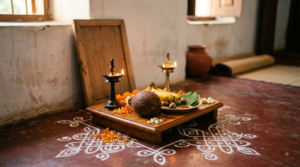
- Clean the pooja area thoroughly the previous evening, then draw a rangoli or kolam there.
- Place a small wooden mane, clean it, and mark a kolam on it as well.
- Set a Ganesha idol on the mane first and pray for an obstacle-free completion.
- Place Rayaru’s photo above it after wiping the frame and applying sandal paste and kumkum.
- Decorate the photo with fresh flowers and set a lamp on either side.
- Position the mane centrally, leaving enough clearance to walk right around it.
- Arrange fruit, an unbroken coconut, betel leaves and betel nuts in front as naivedya.
- Light the lamps and state your sankalpa aloud, naming the duration and the purpose.
- Offer deepa, dhoopa and naivedya in that order.
- Walk at least 11 pradakshinas around the photo, chanting the Poojyaya shloka each round.
- Close with namaskara, then repeat the pradakshinas and namaskara again in the evening.
- Repeat every step daily until the vow ends, then break the coconut the next morning.
Morning and evening rhythm
Wake early and bathe before the morning session, since the vrata assumes a clean start to the day. Men traditionally wear a white dhoti and women a saree, washed the previous day and dried separately as madi. Wash the clothes ahead of time, otherwise day one begins in a rush.
The evening session is shorter. Light the lamps again, complete the pradakshinas and namaskara, and leave the arrangement undisturbed overnight. Change the flowers daily so the offering stays fresh.
Fasting Rules During the Raghavendra Swamy Vratam
Fasting during the vrata is moderate rather than severe. The traditional pattern allows one proper meal in the morning, taken after the pradakshinas are done. Devotees skip dinner. When a full night fast feels too hard, fruit and milk work instead.
Alongside food, the older instructions ask for restraint of a broader kind. Sleep on the floor on a clean mat rather than a bed. Keep television, films and idle scrolling aside for the duration. Avoid gossip, and hold Rayaru in mind through the ordinary hours of the day.
A brief health note: skipping dinner for several days is not safe for everyone. If you are diabetic, pregnant, elderly, recovering from illness or on regular medication, speak to your doctor first and take the fruit-and-milk option without hesitation. No vrata in this tradition is a substitute for medical treatment, and the discipline is never meant to damage your health.
What You Need Before Day One
- A framed photo or small idol of Sri Raghavendra Swamy, plus a Ganesha idol.
- A wooden mane or a low clean stool, with space around it for walking.
- Two lamps, oil or ghee, wicks, camphor and incense.
- Sandal paste, kumkum, fresh flowers for every day, and rangoli powder.
- One unbroken coconut, seasonal fruit, betel leaves and betel nuts.
- Clean traditional clothing washed a day early, and a floor mat for sleeping.
Nothing here needs to be new or expensive. Most households already own three quarters of the list, so the Raghavendra Swamy Vratam costs very little to keep. That low barrier explains its reach across income levels.
When to Start, and the Aradhana Window
Thursday is the customary start day, though tradition also permits any auspicious day. Many devotees deliberately time a vrata so that it finishes on or near Aradhana, when Rayaru’s Brindavana entry is commemorated.
The official Matha has announced the 355th Aradhana Mahotsava at Mantralaya from 27 August to 2 September 2026, with the three core Aradhana days falling on 29, 30 and 31 August 2026. Note that an extra lunar month pushed the festival almost three weeks later than usual this year, so early-August dates still circulating online are wrong. Our Raghavendra Swamy Aradhana 2026 schedule breaks the week down day by day.
When the Raghavendra Swamy Vratam Does Not Go to Plan
No published tradition promises that a vrata will be smooth or that the outcome is assured. Things do go wrong, and the official pages never discuss it. Here is what devotees commonly face.
Illness, travel or an unavoidable break
If illness or an emergency interrupts the vow, stop without guilt and resume a fresh sankalpa later. Do not fast through a fever to protect a technicality. Where a family priest is available, ask him whether a short prayaschitta suits your tradition, because practice varies between families.
Menstruation during the vrata
Households differ sharply on this. Some pause the vow and restart afterwards, while others hand the pradakshinas to another family member. Since no single ruling covers every parampara, follow your own family custom or ask a mutt priest rather than an internet comment thread.
The coconut spoils or the lamp goes out
On longer vows a coconut can spoil in humid weather, and devotees regularly ask about replacing it. Priests at Rayaru temples are the right people to settle that, though many families simply replace it and continue. A lamp blowing out is treated as an accident, not an omen.
No dream, no visible result
Folklore says a devotee may receive a dream connected to the purpose of the seva. Treat that as belief, not as a pass mark. Nothing in the tradition says a vrata without a dream has failed, and reading it that way causes needless distress.
Myths About the Raghavendra Swamy Vratam, Corrected
Aggregator pages repeat several claims that do not survive checking. Correcting them is the most useful thing this guide can do.
- “It must be exactly three days.” False. Three is the common minimum, while 5, 7, 9 and 11 days are equally accepted.
- “You must do 108 pradakshinas.” Not so. The published minimum is 11 per session, and 108 is a personal choice.
- “A website can perform the vratam for you.” No. A vrata is a personal vow, so nobody can keep your sankalpa for you.
- “You must book it through the Matha.” Untrue. There is no booking, no fee and no counter for a home vrata.
- “Only certain families may keep it.” The published procedure sets no such bar; sankalpa and sincerity are what it asks for.
The third and fourth points matter for your money as well as your faith. Sites that ask for payment to perform a personal vrata on your behalf are not the Matha, so verify any seva request on the official portal before paying anyone.
Home Vrata, Mantralaya Seva or a Local Mutt?
| Option | Best for | Practical reality |
|---|---|---|
| Vrata at home | Anyone, anywhere, at any time | Costs very little and needs no travel or permission |
| Seva at Mantralaya | Devotees who can travel to the Brindavana | Arranged and paid only through the official Matha portal |
| Pradakshina at a branch mutt | City devotees near a Rayaru mutt | Timings and customs vary, so check locally before starting |
Many devotees combine the two. They keep the Raghavendra Swamy Vratam at home, then offer a seva at Mantralaya or a branch mutt afterwards as a thanksgiving.
What Beginners Usually Get Wrong
Starting without preparing the clothes is the most frequent slip, because madi cannot be arranged on the morning itself. The second is choosing eleven days out of enthusiasm and quietly stopping on day four.
Others leave too little floor space around the mane, which makes eleven rounds awkward in a small pooja room. Some also forget that the coconut has to remain unbroken until the vow closes, and open it a day early by mistake. Learning the shloka in advance solves a fourth problem, since counting rounds and reading text together rarely works.
Before You Begin
The Raghavendra Swamy Vratam asks for very little equipment and a great deal of steadiness. Fix a duration you can honestly complete, prepare the clothes and the samagri a day early, and learn the shloka before day one. Keep the fast in its moderate form if your health needs that, because the tradition allows it and your wellbeing comes first. Then hold the sankalpa to its close and break the coconut on the morning after.
For anything transactional — sevas, donations or rooms at Mantralaya — go straight to the official Matha at srsmatha.org. Background on Rayaru’s life and lineage is also documented on his encyclopaedic biography.
Frequently Asked Questions
Can I keep the Raghavendra Swamy Vratam without a priest?
Yes. It is a personal vow you perform at home, so you need no priest, booking or temple permission. You state the sankalpa yourself, complete the daily pradakshinas, and close the vow on your own. A priest is only worth consulting if a family-specific doubt arises.
Which day should I start the vrata on?
Thursday is customary, because Guruvara belongs to Rayaru. Tradition also allows any auspicious day that suits you. Many devotees begin on a Thursday so the vow ends on a Saturday or Sunday, which makes the final morning easier to manage at home.
Do I have to fast completely during the Raghavendra Swamy Vratam?
No. The usual pattern permits one morning meal after the pradakshinas and skips dinner. If a night fast feels difficult, fruit and milk work well. Anyone with a medical condition should take the lighter option and speak with a doctor first.
How many pradakshinas are required each day?
A minimum of 11 pradakshinas per session is the widely published figure, done morning and evening. Devotees who wish to do more may, though the count should stay consistent across all days of the vow once you have started.
What do I do with the coconut at the end?
Break it on the morning after the final day and share it with the family as prasada. Keep it unbroken and undisturbed for the whole vrata until then, since it stands as the physical marker of the sankalpa you took.
Can the vratam be done at Mantralaya instead of at home?
Devotees do perform pradakshinas and sevas at the Brindavana, but formal sevas there are arranged and paid for only through the official Matha. A home vrata remains a separate, personal observance that needs no arrangement with the Matha at all.
Is the Raghavendra Swamy Vratam linked to Aradhana?
The Raghavendra Swamy Vratam and Aradhana are separate observances. Aradhana is the annual Mahotsava at Mantralaya marking Rayaru’s Brindavana entry, and in 2026 the Matha has announced it from 27 August to 2 September. Some devotees time a personal vrata to conclude during that window, though nothing requires it.
What if I miss a day midway through?
Stop, and begin a fresh sankalpa when circumstances allow. Nothing in the tradition treats an interrupted vow as a spiritual failure, especially when illness or an emergency caused it. Ask your family priest if you want a customary observance to mark the break.