A Rayaru mandir at home needs only a clean corner, a raised wooden seat, and his image to begin. You do not need a priest, a costly cabinet, or a special initiation to keep Sri Raghavendra Swamy at home. What you do need is the right spot, a thoughtful arrangement, and a little care so the space stays clean and calm. This guide walks you through choosing the direction, picking a photo or a mrittika Brindavana, and arranging everything the way Madhwa families actually do.
Please note: srsmatha.org.in is an independent devotional guide for Rayaru’s devotees. We are not the official Sri Raghavendra Swamy Mutt, and we are not affiliated with or endorsed by it. We take no bookings, sevas, donations, or payments. For seva bookings, room reservations, and e-hundi, always use the official Mutt website, srsmatha.org.
Rayaru Mandir at Home: Quick Setup Checklist
Here is what a simple home shrine for Rayaru actually needs, so you can gather everything before you start.
- Best direction: the northeast corner (Ishan Kona), or the east or north if that corner is taken.
- The seat: a wooden plank, low chowki, or mane raised at least a foot and a half off the floor.
- The image: a framed photo, a small idol, or a mrittika Brindavana of Sri Raghavendra Swamy.
- Company: a small Ganesha nearby, since Hindu worship begins by remembering him first.
- Lamps: one or two ghee or oil lamps, placed on either side of the image.
- The spirit: keep it clean and simple, because sincerity matters far more than scale.
Where to Place a Rayaru Mandir at Home
The best place for a Rayaru mandir at home is the northeast corner of the house, known in Vastu as the Ishan Kona. If that corner is not free, the east or north side works well too. These zones stay quieter, catch balanced morning light, and let you sit facing east while you pray.
Vastu treats the northeast as the most sacred quarter for any prayer space. So a dedicated northeast pooja room is ideal when you have the room for one. In a flat where space is tight, simply pick the northeast corner of the living room instead. Keep the mandir against a corner rather than a central wall, and raise it off the floor.
Directions and spots to avoid
Some placements work against a calm routine, and a few carry a clear traditional caution. The south and southwest are best avoided for the mandir, because tradition links them to heavy, downward energy. The southeast is the fire corner tied to the kitchen, so it suits cooking rather than prayer.
Keep the mandir out of the bedroom where you can, and never set it inside, above, or below a bathroom wall. Avoid tucking it under a staircase or inside the kitchen. If a shared studio flat leaves you no choice, screen the shrine with a small curtain or cabinet doors, and keep it as clean and separate as possible.
What Goes Inside a Rayaru Mandir at Home
At the heart of a Rayaru mandir at home sits his image, and you have three honest choices. A framed photo is the simplest and works perfectly for most families. A small metal idol suits those who want a three-dimensional murti. A mrittika Brindavana, a little replica of his Brindavana, is the most cherished option for many devotees.
Photo, idol, or mrittika Brindavana
A mrittika Brindavana is a small model of the Mantralaya Brindavana, often made from sacred clay or stone powder. Devotees keep it as a living presence of Rayaru rather than a mere picture. You can buy one from the official Mutt outlets or trusted devotional stores, and many are simply consecrated with a lamp and prayer at home.
If you are just beginning, a clean framed photo is genuinely enough. You can always add an idol or a Brindavana later, when your routine settles. Whichever you choose, place a small image of Lord Ganesha and, if you wish, Mukhya Prana (Hanuman) nearby, since the Madhwa tradition holds both in great regard.
How to Arrange the Altar the Right Way
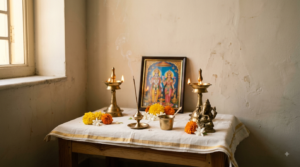
Once the direction and image are decided, arrangement is the next step, and it is where small details help. Set the image so Rayaru faces east or west, which means you sit facing east or west during prayer. Leave a small gap of about an inch between the frame and the back wall for air and light.
Place the seat, or mane, at a comfortable eye level when you sit, roughly a foot and a half to two feet above the floor. Keep a lamp on either side, and set the incense holder and a small water cup in front. If the corner allows a little room around the seat, you can do a gentle pradakshina, or circle, while chanting his name.
The Madhwa Way: Where Rayaru Sits in Your Shrine
This is the part most generic Vastu guides miss, yet it matters to Rayaru’s devotees. In the Madhwa (Dvaita) tradition, the order is clear: Hari Sarvottama, Vayu Jeevottama. That means Lord Vishnu is supreme, Mukhya Prana comes next, and revered gurus like Rayaru guide us toward them.
So if your shrine already holds a family deity such as Sri Rama, Krishna, or Panduranga, keep that deity at the centre or slightly higher. Rayaru’s image sits alongside as your guru, not above the Lord he himself worshipped. Many families keep it beautifully simple with just Rayaru’s photo and a Ganesha, and that is completely valid too.
There is a gentle custom worth knowing. At Mantralaya, devotees pray to Manchalamma, the village goddess, before Rayaru’s Brindavana. You cannot recreate that at home, yet the spirit of it, humility before approaching the guru, is easy to carry into your daily prayer.
Setting Up a Rayaru Mandir at Home: Step by Step
Here is the practical sequence for putting the shrine together for the first time. Take it slowly, because a settled setup you rarely need to move is worth the extra care.
- Pick and clean the spot. Choose the northeast corner, then wipe the wall, floor, and shelf until they are spotless.
- Raise the seat. Set a wooden plank, chowki, or shelf at least a foot and a half above the floor, never directly on the ground.
- Cover it cleanly. Lay a fresh cloth in a light colour such as white, cream, or soft yellow over the seat.
- Place the image. Set Rayaru’s photo, idol, or Brindavana facing east or west, with Ganesha to one side.
- Add the lamps. Position one or two lamps on either side, and keep a matchbox and wicks within reach.
- Arrange the small items. Set the incense holder, a bell if you have one, kumkuma, akshate, and a water cup neatly in front.
- Light the first lamp. Light a ghee lamp, offer a flower, and quietly invite Rayaru to bless the space.
Once the mandir stands ready, your daily or weekly worship becomes easy to keep up. For the actual prayer routine, our guide to the Raghavendra Swamy home pooja on Thursday walks through each step of the worship itself.
Common Myths About a Rayaru Mandir at Home
Plenty of confusing claims float around online, and clearing them up saves real worry. Setting up a Rayaru mandir at home is meant to be joyful, not a source of fear about rules.
- “You must do a strict fasting vratam to keep his photo.” Not true. Keeping Rayaru’s image and offering simple daily or Thursday worship is entirely fine on its own. The 3, 5, 7, or 11-day sankalpa seva with fasting is a separate, optional vow for a specific wish.
- “A mrittika Brindavana needs temple-grade abhisheka daily.” No. Respectful daily care, a lamp, and clean surroundings are enough at home. If you want a formal ritual, ask a Madhwa priest or the Mutt.
- “You need special initiation to worship Rayaru.” Anyone may keep his image and pray with devotion. His tradition is famously welcoming to all sincere hearts.
- “A dream of Rayaru is proof the seva worked.” Treat such promises as folklore. Devotees describe his grace as faith, not a guaranteed sign on demand.
Caring for Your Home Mandir
A shrine stays powerful mainly through cleanliness and regular attention. Wipe the seat and images every few days, and clean the lamp so it lights easily. Replace old flowers rather than letting them wither in place, since fresh offerings keep the space pleasant.
Trim and clean the lamp wicks so the flame burns steady and safe. Keep a small mat or plate under the lamp to catch oil, and never leave a flame unattended near a curtain. If you travel, it is fine to pause daily worship and simply resume when you return, because Rayaru’s grace does not hinge on an unbroken streak.
Faith, Safety, and Bookings: A Quick Word
The blessings devotees connect with Rayaru belong to the world of faith and tradition. Cherished stories of healing and rescued fortunes are shared as devotion, not as medical or financial guarantees. Please hold them in that spirit, and never treat any ritual as a substitute for a doctor’s care.
If you plan a longer sankalpa seva that involves fasting, keep it within your health limits. Anyone who is diabetic, pregnant, elderly, or on regular medication should adjust or skip the fast and check with a doctor first. His grace never asks you to push your body past what it can handle.
For any booking at Mantralaya, use only the official Mutt website, srsmatha.org. Be careful of fake portals that copy official-looking names to collect payments to private accounts. A genuine booking always happens on the Mutt’s own site, so avoid any page demanding an upfront processing fee.
Before You Begin
Setting up a Rayaru mandir at home comes down to a clean northeast corner, a raised seat, his image, and a lamp. Arrange it with care, respect the Madhwa order of Hari first and guru alongside, and keep the space simple and tidy. Let it become a quiet daily habit rather than a burden of rules.
For anything official at Mantralaya, use srsmatha.org, and let this guide simply help you honour Rayaru at home with a settled heart. You can read more about his life in our history of Sri Raghavendra Swamy.
Frequently Asked Questions
Which direction should a Rayaru mandir at home face?
Place the mandir in the northeast corner, and set Rayaru’s image so he faces east or west. This lets you sit facing east while praying, which tradition considers most auspicious. If the northeast is unavailable, the east or north side works well.
Can I keep a mrittika Brindavana at home?
Yes, you can keep a mrittika Brindavana of Rayaru at home. It is a small replica of his Mantralaya Brindavana and is treated as his living presence. Simple daily care, a lamp, and clean surroundings are enough; you do not need temple-grade rituals.
Is a photo enough, or do I need an idol or Brindavana?
A framed photo of Rayaru is perfectly enough to begin. An idol or a mrittika Brindavana is optional and can be added later. What matters most is a clean space, the right direction, and a sincere mind.
Do I need to fast just to set up the mandir?
No, setting up the mandir and keeping Rayaru’s image needs no fasting at all. Fasting only relates to a longer sankalpa seva that some devotees choose for a specific wish. Keep any fast within your health limits and consult a doctor if you have a condition.
Where should Rayaru’s image sit if I already worship other gods?
Keep your main deity, such as Rama or Krishna, at the centre or slightly higher. Rayaru’s image sits alongside as your guru, since the Madhwa tradition places Hari as supreme. Many homes also keep it simple with just Rayaru’s photo and a Ganesha.
Can women set up and worship at a Rayaru mandir?
Yes, anyone with devotion may set up and worship at a home mandir for Rayaru. His tradition welcomes all sincere devotees. Customs during menstruation vary from family to family, so follow what feels right within your household’s practice.
What day should I start the mandir setup?
Thursday, or Guruvara, is the most auspicious day to begin, because Rayaru entered Brindavana on a Thursday. You may also start on any festival day or a personally significant date. The sincerity you bring matters more than the exact day.
How do I book a seva or room at Mantralaya?
Book only through the official Sri Raghavendra Swamy Mutt website, srsmatha.org. It is the trusted channel for sevas, room reservations, and e-hundi. Avoid unofficial pages or agents that ask for advance payments to private accounts.